More media 10
Description
History usually doesn’t always reveal itself in a clean straight line. Sometimes it appears in a stack of faded yellowing carbon copies, each one a different piece to a puzzle, in a box nobody ever labeled, hidden in an old, dark, musty attic. That’s a slightly dramatized version of what I experienced several weeks ago. I wasn’t exactly searching for a smoking gun.
When it comes to researching the history of Operation Majestic 12, aka, “The Program Who Must Not be Named,” a few people actually went out of their way earlier this summer to shout at me in all caps that I “would never find anything no matter how hard I tried.”
But I have not spent too much time in the ufology world, however, and as a result enter this subject with zero long-held assumptions about how any of this “should” look. For context, I actually didn’t even know what Majestic was 12 months ago! Which is to say my goal has been instead to simply cut the crap and understand what, exactly, happened in the chaotic months and weeks and days leading up to 24 September 1947—when President Truman allegedly signed off on the creation of Majestic 12.
And then the documents started lining up with each other in a way that felt less like research and more like that beautifully transcendent opening chord progression to that most iconic song, “Everything in its Right Place.” (Yes, I am a Radiohead-head).
It began months earlier, on 31 March 1947, with one quiet letter from James Forrestal that looks at first glance like routine administrative maintenance. He wants a list of “outstanding administrators” who could take on confidential assignments. The criteria are unusually specific and sharp: successful, between 30 and 50 years old, financially independent, politically neutral, and, crucially, they must not know they’re being considered. At the time it reads like harmless bureaucracy. In hindsight, it feels like a template (because it was!).
Then everything accelerates in August.
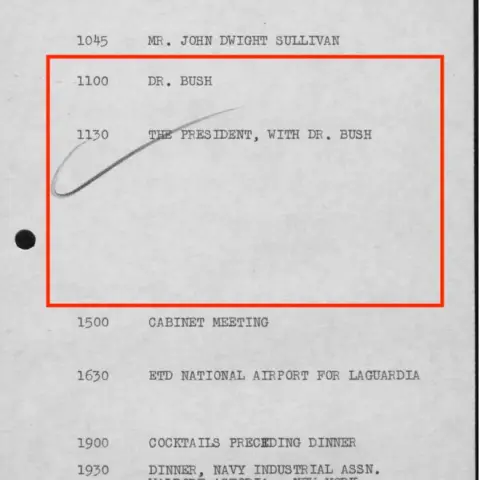
On August 11, Forrestal writes Dr. Vannevar Bush, saying he wants to speak with him “not merely about research *but about other features*.” That single phrase is extraordinary. It’s oblique on purpose. It signals that whatever Forrestal needs to discuss cannot be written down.
Then, only ten days later, on August 21, Forrestal writes to Robert Patterson and lays out the names for the top positions in the new security framework: Hargrave, Souers, Hill, Bush. He notes the list is confidential until the public announcements, and asks him to ensure these names do not leak publicly. Behind the scenes, the personnel architecture is taking shape.
On August 28, Forrestal’s Special Assistant Marx Leva sends a curated packet of dossiers and photographs to the White House. The cover memo lists Arthur M. Hill, Sidney Souers, Admiral Hillenkoetter, and General Gruenther. All key figures. All central to the early Cold War intelligence structure.
But the next pages—the way the dossiers are sequenced in the pdf—are what matter… and Then came the moment that floored me.
Because Right after that cover memo sits a two-page, officially prepared government dossier dated August 26, 1947.
And when I saw the name my jaw dropped.
It was the one. The only. The Godfather.
The name at the top is Vannevar Bush.
Not a lore document. Not a leak. Not Rick Doty’s fan fiction. A real, contemporaneous dossier included among a handpicked group sent directly to the White House less than a month before MJ-12’s alleged creation. That was the moment the ground shifted under me. Forrestal didn’t just send the White House Hill, Souers, Hillenkoetter, and Gruenther. He included Bush, in the same internal packet, at the exact time the secret interagency architecture was being wired into place.
And before anyone tries to wave this off as simple PR prep for the National Security Act, that explanation doesn’t survive five seconds of historical reality. Truman already knew Souers, Hillenkoetter, Hill, and Bush extremely well; these were men who briefed him personally, often weekly. Forrestal did not need to send the White House internal dossiers and photographs on the President’s own inner circle unless something far more restricted was being assembled behind the scenes.
The rest of the packet reads like the cast list for a hidden governance structure coming online: Souers, the first Director of Central Intelligence and Truman’s confidant (who had just written a report in July 1947 on the AEC’s intelligence needs); Hillenkoetter, already inside Truman’s daily briefings as head of CIA; Arthur Hill, the Navy’s logistical strategist; and General Alfred Gruenther, Eisenhower’s prodigy. Forrestal even includes portrait photographs within these dossiers.
When you lay the documents together, the timeline becomes increasingly difficult to ignore. March 31: Forrestal asks for a secret list of candidates who must not know they’re candidates. August 11: he signals to Bush there is something to discuss that cannot be put on paper. August 21: he circulates a private personnel blueprint. August 26: Bush’s dossier is prepared. August 28: the White House receives the curated packet, including Bush’s dossier which is provided with zero written explanation. And four weeks later—September 24—comes the alleged formation of MJ-12.
This is neither myth-making nor speculatively retrofitting old documents onto a modern legend. This is what the U.S. government was actually doing at the exact moment MJ-12 supposedly came into existence. And once I saw Bush’s dossier appear in that exact sequence, the story stopped being speculative and started becoming visible.
Part III is coming.
And it only gets stranger.
Comments 0
Sign in to join the discussion.
What do you think it is?
Sign in to vote. 0 votes.
👥 Other witnesses
🙋 I saw this tooSaw it too? Add your account — independent witnesses are the best evidence.
🔔 Alerts for sightings like this
Source
u/MAJESTICJEHOVAH on r/UFOs
Citations
https://www.reddit.com/r/UFOs/comments/1qc4j69/new_archival_find_the_…
Similar sightings described alike
 SERIOUS–James Forrestal's 24-26 September 1947 Diary Entries Corroborate MJ-12 Origin Narrative
 📌 New evidence corroborates Majestic documentsRoswell
 📌 Devastating news for Roswell scepticsRoswell
 My Thoughts on The UAP/NHI/ORBS & 3i/atlas & GovernmentOregon
 Two Days After Hiroshima, Truman Directed His Navy Secretary to Launch an “Experimental Airplane Development Program”Hiroshima
 My observation - finally after 20 years I decided to present my story to a wider audience - UPDATE and some important topic
 "2027": Is there reasoning for the "2027" date being relevant to disclosure based strictly upon U.S. classification laws? (tl;dr: yes, potentially)2024
 Do Historical “Sky Battles” Resemble Modern UAP Reports? A Source-Critical Study of Nuremberg 1561, Basel 1566, Stralsund 1665, and the PURSUE FilesNuremberg
No comments yet. Start the conversation.