Ariel School UFO incident
From the UAP Encyclopedia, the open encyclopedia of UFO and UAP history · 🛸 Case
Contents 16
Summary
On September 16, 1994, at the Ariel School near Ruwa, Zimbabwe, 62 pupils reported seeing one or more silver craft and small figures dressed in black during their mid-morning break. The fifteen-minute encounter led to investigations by local researcher Cynthia Hind and Harvard psychiatrist John Mack, who interviewed the children. While ufologists view the event as strong evidence of extraterrestrial visitation, skeptics have suggested explanations including mass hysteria, a prank, or a puppet show.

| Type | Case |
|---|---|
| Also known as | Ariel School; the Ruwa encounter |
| Date | 16 September 1994, about 10 a.m. |
| Place | Ariel School, near Ruwa, Zimbabwe |
| Witnesses | 62 pupils aged 6 to 12 |
| Duration | About 15 minutes |
| Investigators | Cynthia Hind, John E. Mack |
The Ariel School UFO incident is the report by 62 pupils of Ariel School, a private primary school near Ruwa in Zimbabwe, that on the morning of 16 September 1994 one or more silver craft came down in a patch of bush beside their playing field and that small figures dressed in black emerged. The children, aged between six and twelve, were outside for their mid-morning break while the teachers were in a staff meeting.[1][2] Several of them later said the figures had passed on a message, without speaking, about the harm people were doing to the Earth.[1][2]
The case drew the BBC's correspondent in Zimbabwe, the local investigator Cynthia Hind and the Harvard psychiatrist John Mack, who interviewed the children within days and weeks of the event. The Fortean writer Jerome Clark called it the most remarkable close encounter of the third kind of the 1990s, and it is still cited by ufologists as strong evidence of extraterrestrial visitation.[1][2]
Skeptics have explained it as mass hysteria shaped by a wave of UFO reports two days earlier and by the way the children were interviewed; other suggestions include a prank, a touring puppet show and a dust devil. Not every pupil outside that morning reported seeing anything, but many of those who did have stood by their accounts as adults.[1][2][3]
Background

Ruwa and the school
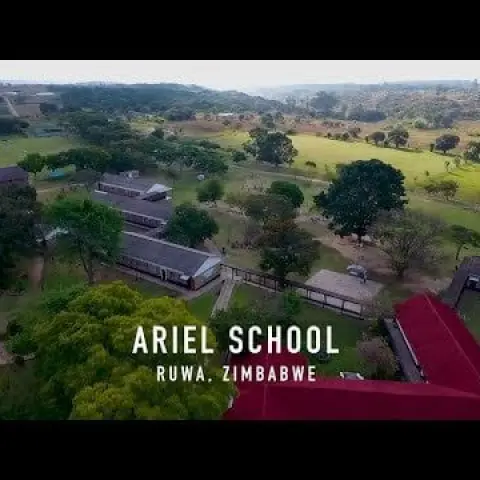
Ruwa is a small farming centre about 22 kilometres south-east of Harare, the capital of Zimbabwe; Cynthia Hind gave the drive from Harare as 35 kilometres. In 1994 Ruwa was little more than a crossroads and a place-name among farms; skeptic Brian Dunning notes that it has since become a suburb of Harare, and that the school lies about fifteen minutes' drive from Ruwa along the R5 road.[1][2][3]
Ariel was an expensive private school, and many of its pupils came from well-off families in Harare. Dunning describes the 1994 pupils as mostly white Zimbabweans of British and South African descent, taught in English. The Mail & Guardian's Sean Christie describes a more mixed school: Black children from several ethnic groups, children of mixed race, children of Indian descent and white children, most of them born in Zimbabwe. The pupils wore khaki uniforms with red floppy hats.[1][2][3]
Accounts differ on how many people were at the school that day. The Mail & Guardian gives a figure of more than 110 children and staff, while Dunning says about 250 children were out in the playground; on his figures, roughly three-quarters of them saw nothing unusual.[1][2][3]
Beyond the playing field, according to Hind, the ground was rough: long grass, thorn trees and other native bushes, and dense undergrowth, with trees growing in no particular order. A line of power cables ran nearby.[3]
The fireball of 14 September
Two nights before the school sighting, on Wednesday 14 September 1994, a bright fireball crossed the sky over southern Africa. Hind recorded it between about 8:50 and 9:05 p.m.; Dunning puts it at about 9 p.m. It was reported as far away as Zambia and Botswana. Astronomers described it as a meteor shower, and Hind received dozens of reports describing a capsule-shaped ball of fire with flames trailing behind it, flanked by two smaller capsules.[2][3]
Dunning identifies the fireball as the upper stage of a Soviet-designed Zenit-2 rocket, used to launch the satellite Cosmos 2290, falling back to Earth. The booster broke up into burning pieces that drifted silently across the sky and were seen by millions of people.[1][2]
The state broadcaster ZBC asked radio listeners to call in with what they had seen. Reports ranged from a single shooting star to a fleet of sixteen brightly lit ships, and the episode set off a wave of UFO excitement in Zimbabwe. The announcer also said that the BBC wanted to hear from anyone with information or photographs. Hind logged other sightings in the same period, including a daytime sighting by a young boy and his mother and a lorry driver who said he had seen strange beings on a road at night.[1][2][3]
The sighting

Friday 16 September 1994 was a hot day. At about 10 a.m., during the mid-morning break, the pupils were outside while the adult staff were indoors at a meeting. Children were drawn to the bushy area beyond the playing field, where they said three or four disc-like objects had come in along the line of the power cables and settled among the trees. The children were frightened but also curious.[1][3]
The descriptions varied from child to child. The objects numbered from one to several; they were silver and usually described as discs; some children said they appeared suddenly or darted about, others that they drifted down slowly. They stopped over, or landed in, the field of brush and small trees just outside the school grounds.[1][2]
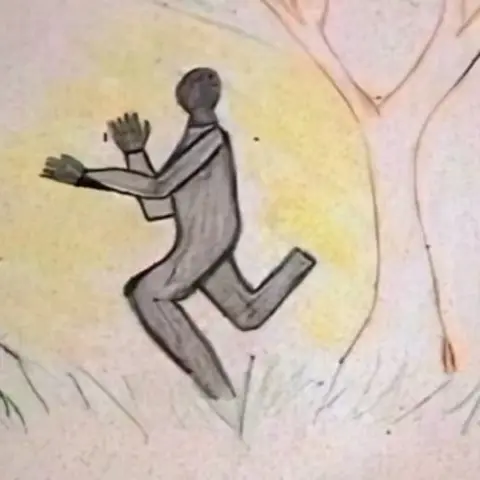
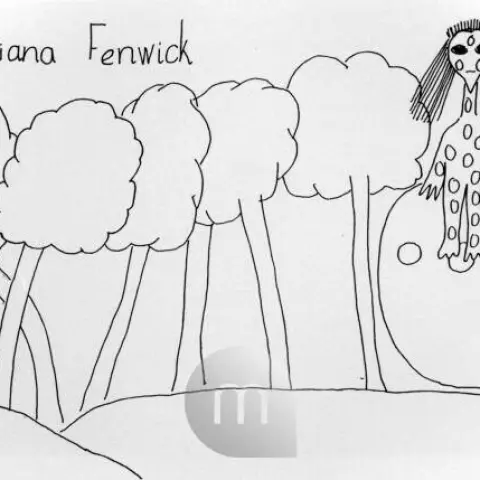
Between one and four figures were reported on or beside the craft. Most children described small beings with large eyes, dressed entirely in black; some described them as ordinary-looking Black men. One pupil, quoted by Hind as Guy G., said the small man was about a metre tall and wore a shiny black suit; he had long black hair, large elongated eyes set lower in the face than a human's, a mouth like a slit and ears that could barely be seen. A white pupil first took the figure for the gardener of a woman in the area, then noticed its long, straight black hair and changed his mind.[1][2][3]
Some Black pupils took the figures for zvikwambo or tokoloshes, small malevolent creatures of Shona and Ndebele folklore, and cried in fear of being eaten. Many children ran away; others, mostly the older ones, stayed to watch. The whole encounter lasted about fifteen minutes. The craft then faded, left quickly or vanished, according to different accounts.[1][2][3]
The only adult near the children was the woman who ran the school's tuck shop. When the children came back, she was crowded by pupils talking about the objects, some scared and some excited. In class the children told their teachers, who at first dismissed them and told them to be quiet; one former pupil recalled that the children came back talking about little men. That evening many told their parents, and the next day the school took calls from parents asking why their children were upset, and many came in to talk it over with the staff.[1][3]
The children were adamant that what they had seen was not an aeroplane.[1]
Investigation

The BBC
The BBC's correspondent in Zimbabwe, Tim Leach, filmed interviews with pupils and staff at the school on 19 September 1994. He later said he could handle war zones, but not this.[1][4] According to Dunning, Leach had phoned his friend Cynthia Hind after the ZBC appeal; through that call Hind heard about the Ariel report, which someone had passed to ZBC, and she suggested that Leach contact John Mack.[2]
Cynthia Hind
Cynthia Hind was a Zimbabwean UFO researcher who for about fifteen years investigated sightings across Africa as the continent's representative of the Mutual UFO Network (MUFON), and edited the newsletter UFO Afrinews. She said she had had experiences of her own with otherworldly beings. She died in 2000.[2][3]
Hind visited the school on 20 September 1994, four days after the sighting. She spoke to children in small groups and asked them to draw what they had seen, and she reported that their stories matched. She filed the school sighting as her Case 96; the fireball two nights earlier was Case 95, written up in issue 11 of UFO Afrinews under the title "UFO flap in Zimbabwe". She called the Ariel report one of the most exciting UFO stories of that or any year, and argued that because the witnesses came from different cultures, both their differing interpretations and the details they shared made the case more convincing. She also noted that not all the children believed they had seen beings from another planet.[1][2][3]
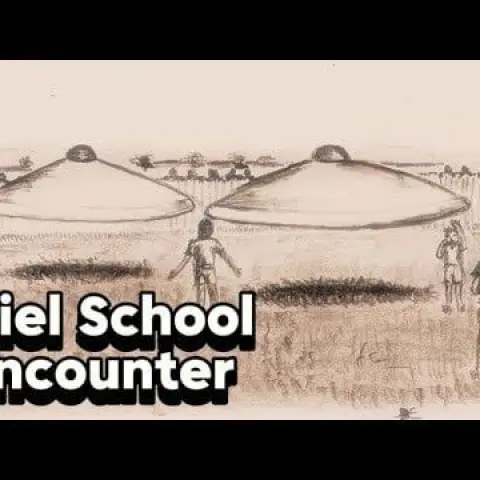
Hind photocopied 22 of what she considered the clearest drawings. Those most often reproduced show a classic flying saucer on landing legs, with a row of windows around its middle and a dome on top; Dunning says most of the other drawings look quite different. When a skeptic on the television programme Sightings suggested the children had picked up the images from films and television, Hind replied that many of them did not go to the cinema because they lived in the countryside, where their parents farmed.[2] Hind ended her report by criticising the parents who refused to believe their children.[3]
John Mack
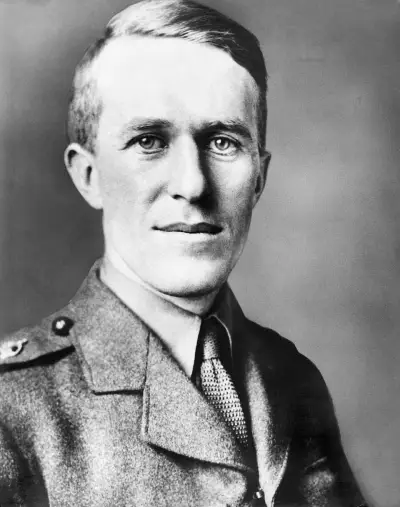
John E. Mack was a professor of psychiatry at Harvard Medical School who had won the 1977 Pulitzer Prize for A Prince of Our Disorder, his biography of T. E. Lawrence. In the early 1990s he began studying people who said they had been abducted by aliens, and earlier in 1994 he had published Abduction: Human Encounters with Aliens. That spring a Harvard dean set up a small committee to examine his work; the dean suggested the trouble was that the book proposed a change in our view of reality rather than a new psychiatric syndrome. A Johns Hopkins psychiatrist quoted by the Los Angeles Times described Mack as brilliant but prone to losing his way. Mack kept his post, and by mid-1994 he was planning to look into encounter reports in Africa, including a meeting with the traditional healer and author Credo Mutwa, when news of the Ariel sighting changed his plans.[2][3]
Mack came to Zimbabwe about two months after the sighting, in November 1994, with his colleague Dominique Callimanopulos. According to Hind, he gave two radio interviews and one television interview before driving out to Ruwa, and he persuaded parents and teachers that, whatever they thought of the children's story, calling them liars would do harm. Many of his interviews with the children were videotaped.[1][2][3][4]
In those interviews several children said the beings had communicated with them through their eyes rather than by speaking. One girl described the eyes as frightening and said they stared as if the being wanted to take the children; another said the man never spoke and the message came through his eyes. A fifth-grade boy named Francis said he had been warned that something was going to happen and that pollution must stop. Emma, aged eleven, said she thought the beings wanted people to know that humans were harming the world and should not become too dependent on technology. Another child said he was told the world would end because people were not looking after the planet.[1][2][3]
Mack concluded that the children were telling the truth and that something real had visited the school. Other people he had interviewed had also described urgent messages about the damage humans were doing to the planet's ecology, and in his later book Passport to the Cosmos he wrote that such messages might be central to the abduction phenomenon. He died in a road accident in London in 2004; his supporters and family then founded the John E. Mack Institute.[2][3]
Explanations

Mass hysteria
Skeptics have most often explained the sighting as mass hysteria. Dunning points to a 2011 review in the Malawi Medical Journal which found that outbreaks of mass hysteria are fairly common in African schools and that the social and psychological setting plays a large part in them. In his view the setting at Ariel clearly mattered: the sighting came two days after the fireball and in the middle of a national wave of UFO reports.[1][2]
Dunning also disputes the idea that the children had never been exposed to images of flying saucers and aliens. He argues that pupils at the area's most expensive private school, from wealthy Harare families, watched the same films and television as city children, including the heavy UFO coverage in Zimbabwe's media after the fireball.[2]
How the children were interviewed
Dunning's main criticism concerns the interviews. Witnesses to the same event, he argues, should be questioned separately and soon afterwards. Hind instead spoke to the children in groups of two to six while other pupils were allowed to listen, so that each account could shape the others; Dunning sees this as the reason she found all the stories the same. Mack arrived about two months later, after the children had had plenty of time to talk the event over among themselves.[1][2]
Dunning notes that the telepathic message about caring for the planet does not appear in the material Hind collected before Mack's visit, nor in Leach's reports. It first appears in Mack's interviews, and Hind wrote about it only afterwards. Since Mack was known as an environmental and anti-nuclear campaigner, Dunning argues that he prompted the theme, and that he arrived with firm expectations of what he would find.[1][2]
Other proposals
Dunning concludes that what really happened can no longer be recovered, and that something as ordinary as a couple of people walking through the field or a stray party balloon could have started it; as evidence of alien visitation, he judges, the case falls a little short.[2] Others have suggested a prank. In 2024 Gideon Reid proposed in the journal Scepticisme scientifique that the children may have mistaken one of the touring puppet shows then used in the region to teach about AIDS, literacy or farming, or to sell products. Oliver D. Smith has argued in the newsletter SUNlite that the children may have misidentified a dust devil.[1]
Later accounts

The incident quickly became one of the best-known UFO cases in Africa. In June 2021 an episode of the BBC programme Witness History described it as one of the most significant events in UFO history, and it has been featured at least twice on the American television series Sightings.[1][2]
Many former pupils have kept to their accounts as adults; most have since left Zimbabwe, many of them for Canada or Britain. In 2014 the Mail & Guardian interviewed a former pupil, identified only by a pseudonym, who was by her own reckoning probably the last of the 1994 witnesses still living in Zimbabwe. She said the event had marked her for life, that it had damaged Mack's reputation, that she still feared the beings would return and that she believed she could sense when they were back in the atmosphere; she also said she felt their environmental warnings had come true, pointing to the felling of Zimbabwe's miombo woodlands for firewood.[1][3]
By then the school had grown and appeared to be thriving, but it no longer had any white pupils, as white farming families had left the area after the government's land reforms. The rough ground where the craft was said to have landed had been cleared and mown into a second sports field, and the teachers Christie spoke to knew little of what had happened there in 1994.[3]
In 2016 a former pupil, Emily Trim, exhibited paintings that she described as an expression of the messages she had received that day. In 2021 a Barstool Sports employee known as Zah described on a podcast being at the school as a child and seeing a very bright flash of light before the craft came down and beings got out and walked around.[1][6]
In 2023 a former pupil named Dallyn said in the Netflix series Encounters that he had started the whole thing by telling classmates that a shiny rock in the distance was a UFO, and that he was surprised it had worked. His claim conflicts with an on-camera interview he gave in 2008, in which he described a UFO whose light flashed different colours in the sky, and with the accounts of the other witnesses in the series.[1]
Documentaries
The filmmaker Randall Nickerson began a documentary about the case in 2007, built around the footage of the children's interviews, and in 2008 he was tracking down former pupils, some of them in Cape Town; the project later ran into funding problems. Footage he shot in 2013 shows former pupils, now speaking with American, Australian and English accents, saying that something definitely happened; a former teacher called it the most amazing experience of their lives, and one former pupil said he had never talked about it for fear of being thought mad. Nickerson's film was released as Ariel Phenomenon in 2022.[1][3][5]
Former pupils also appear in the 2020 documentary The Phenomenon, talking about how the experience affected them, and in the 2023 Netflix series Encounters.[1]
See also
- Westall UFO incident, a 1966 sighting by pupils at a school in Melbourne, Australia
- John Mack
- Alien abduction
- 1994 in UFO history
References
- Ariel School UFO incident — Wikipedia · en.wikipedia.org
- Brian Dunning, "The 1994 Ruwa Zimbabwe Alien Encounter", Skeptoid #760 (29 December 2020) · skeptoid.com
- Sean Christie, "Remembering Zimbabwe's great alien invasion", Mail & Guardian (4 September 2014) · mg.co.za
- "The schoolkids who said they saw 'aliens'", BBC News · bbc.com
- Ariel Phenomenon (documentary by Randall Nickerson) · arielphenomenon.com
- "Zah Witnessed One of the Most Notorious Alien Encounters of the 20th Century", Macrodosing podcast, Barstool Sports (6 July 2021) · barstoolsports.com
Facts in this article are drawn in part from the Wikipedia article “Ariel School UFO incident”, available under the CC BY-SA 4.0 licence.
🛸 Sightings & submissions about this 28
 I’m building a classified-style UFO/UAP encyclopedia app, would people actually use this?Rendlesham Forest
 NEW Interview w/ Luigi Vendittelli about His New Documentary on Bob LazarRuwa
 Ariel Phenomenon - Zimbabwe '94 Mass UFO Sighting at School - Q&A w/ Director Randall Nickerson at Yale UFO SocietyZimbabwe
 Quand 62 élèves ont vu des extraterrestresRoswell
 These children ain't lying, that's for sure! What do you think about the Ariel sighting in Zimbabwe in 1994?Zimbabwe
 We Are Not Alone | Demand UFO/UAP DisclosureAriel School
 The Ariel School Encounter in Zimbabwe 1994 (UFO landing)Dec 30, 2024 · Ruwa
 Put this together shortly after the hearings last yearRoswell
 Was Dr John Mack Right About Alien Abductions?Ruwa
 Encounters | Official Trailer | NetflixZimbabwe
 Another Bob Lazar I told you so moment.Ruwa
 What if NHI never planned to annihilate us, but they’ve recently changed their minds?Ruwa
 If ET is concerned with the health of this planet they're most likely concerned with two things. the threat of nuclear war and this:Ruwa
 One of my favourite UFO encounters that is similar to the Zimbabwe UFO encounterZimbabwe
 School kids on witnessing a landed UFO at their school in Broad Haven, Wales, 1977. Similar witness testimony to the Ariel School Encounter.Ruwa
 The Zimbabwe UFO / Melbourne UFO linkZimbabwe
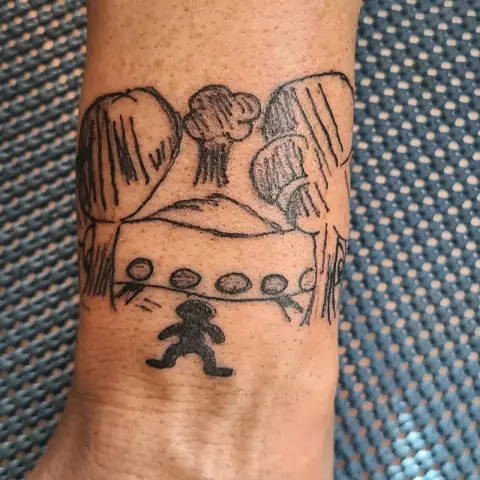 1994 Ariel School (Tattoo)- UFO landing witnessed by dozens of childrenRuwa
 I combined every publicly available detail to recreate the Ariel School UAP LandingRuwa
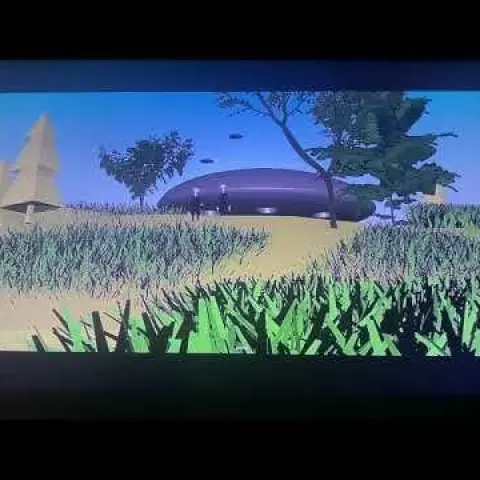 My animation of the Ariel School sighting. (Based off the new evidence in “Ariel Phenomenon”)Ruwa
 This is the most interesting scene in the new ArielPhenomenon movie. This new testimony from Ariel was extremely relatable to alleged abductees.Ariel
 Unexplained Mysteries - 1996 - Ariel School Encounter - ZimbabweRuwa
 A different cut of Ariel School interviews posted by James Fox several months before release of The Phenomenon.Ruwa
 What sightings resemble Bettys "Gray". "appeared nearly human, black hair, dark eyes, prominent nose & bluish lips. Greyish skin" Pic: Ariel encounter
 Zimbabwe School UFO encounterZimbabwe
Showing the 24 newest of 28.
This page was last edited on 31 October 2026. Articles are written in our own words from the sources listed under References; disputed claims are attributed to the people who made them.


No discussion yet.