Coyne helicopter incident
From the UAP Encyclopedia, the open encyclopedia of UFO and UAP history · 🛸 Case
Contents 13
Summary
The Coyne helicopter incident occurred on October 18, 1973, near Mansfield, Ohio, when a U.S. Army Reserve helicopter crew experienced a near-collision with an unidentified grey, cigar-shaped object.

| Type | Case |
|---|---|
| Also known as | Mansfield encounter, Coyne incident |
| Date | About 11 p.m., 18 October 1973 |
| Place | Near Mansfield and Charles Mill Reservoir, Ohio |
| Aircraft | U.S. Army Reserve Bell UH-1H "Huey", serial 68-15444 |
| Crew | Capt. Lawrence J. Coyne, 1st Lt. Arrigo Jezzi, Sgt. Robert Yanacsek, Sgt. John Healey |
| Investigator | Jennie Zeidman (Center for UFO Studies, 1979) |
The Coyne helicopter incident, also called the Mansfield encounter, took place at about 11 p.m. on 18 October 1973, when the four-man crew of a U.S. Army Reserve UH-1H helicopter reported a near collision with an unidentified object near Mansfield, Ohio. The crew said a red light raced towards them on a collision course, stopped above them, and revealed itself as a grey, cigar-shaped object that bathed the cockpit in green light before speeding away — after which they found their helicopter climbing even though its controls were set to descend.[1][2][3]
The case is often called one of the best-documented UFO encounters in the United States, mainly because of the crew's military background, their signed report, and people on the ground who said they saw it too. Skeptics have suggested a meteor, an aerial refuelling tanker, ordinary aircraft and disorientation, and no official explanation was ever given.[1][2][4]
The crew and the flight
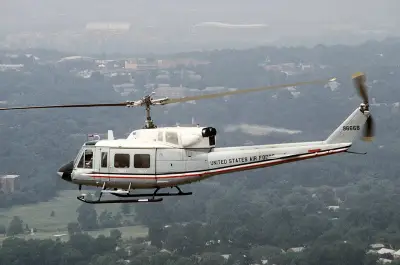
The helicopter, a Bell UH-1H Iroquois or "Huey" with serial number 68-15444, belonged to the Army Reserve flight facility at Cleveland Hopkins Airport. Its four crewmen were members of the 316th Medical Detachment (Helicopter Ambulance), a reserve air-ambulance unit, flying on proficiency duty to keep their flying hours current. They were returning to Cleveland from Columbus, where they had had routine physical examinations — a flight of about an hour and a quarter.[1][3][4]
In command, in the right front seat, was Captain Lawrence J. Coyne, 36, a 19-year veteran of the Army Reserve. First Lieutenant Arrigo Jezzi, 26, the co-pilot, was flying from the left seat. Behind Jezzi sat the flight medic, Sergeant John Healey, 35, and in the right rear seat the crew chief, Sergeant Robert Yanacsek, 23. It was a clear, starry night with no moon, and the helicopter was cruising at 90 knots at 2,500 feet, heading 030 degrees over farmland and rolling hills.[1][3]
The encounter
At about 11 p.m. near Mansfield, Healey saw a red light off to the left, to the west, heading south. Three or four minutes later — at 11:05 p.m. by the official report, east-south-east of Mansfield Airport — Yanacsek noticed a single steady red light on the eastern horizon, at right angles to their flight path. About 30 seconds later he said it was converging on them at the same altitude, at more than 600 knots, on a collision course.[1][3]
Coyne took the controls from Jezzi and began a powered descent, first at about 500 feet a minute and then 2,000 feet a minute, down to about 1,700 feet — some 600 feet above the treetops. He radioed Mansfield tower to ask whether any high-performance aircraft were nearby; the tower acknowledged the call, but then contact was lost on both UHF and VHF radios and no answer came.[1][3]
The crew braced for impact. Instead, just as a collision seemed certain, the light stopped and hovered above and in front of the helicopter. The crew described a cigar-shaped, grey, metallic-looking object with a dome, which filled the entire windshield and blotted out the stars behind it. It had a red light at the nose, a white light at the tail and a distinct green beam from the lower part of its otherwise featureless body. The green beam swung up over the helicopter's nose, through the windshield and into the tinted upper windows, flooding the cockpit with intense green light. They heard no noise and felt no turbulence.[2][3]
After a few seconds the object moved slowly off to the west, then accelerated, passed west of Mansfield Airport and, according to Coyne and Healey, made a distinct 45-degree turn to the north-west, towards Lake Erie.[1][3]
The unexplained climb
While the object was still in sight, Coyne and Jezzi noticed that the altimeter read 3,500 feet and the helicopter was climbing at 1,000 feet a minute, even though the collective — the control that sets the pitch of the rotor blades and raises or lowers the aircraft — was still pushed fully down from the descent. As Coyne raised the collective, the helicopter kept climbing, as expected, and only at about 3,800 feet did he feel he had regained full control. They then felt a slight "bump". Coyne brought the aircraft back down to its assigned 2,500 feet, made easy radio contact with Akron–Canton, and flew on to Cleveland without further incident.[1][3]
The flight plan was closed and the FAA flight service station was told of the incident; it advised Coyne to report it to the FAA's general aviation district office at Cleveland Hopkins. The Army Reserve command was notified at 3:30 p.m. the next day. The crew later attributed the climb to some kind of attractive force, a "tractor beam".[1][4]
The official report
The crew's account was written up on an Army Disposition Form titled "Near Midair Collision with UFO Report", addressed to the flight operations office of the 83rd U.S. Army Reserve Command's flight facility at Cleveland Hopkins and signed by all four men, who attested that they had read it. Dated 23 November 1973, it gives the facts summarised above in brief, official language. It was later reproduced in Lawrence Fawcett and Barry Greenwood's 1984 book Clear Intent.[1][3]
Ground witnesses

At about 11 p.m. a woman identified as Mrs. Erma C. was driving home to the countryside south-east of Mansfield with four children. Heading south on Laver Road, they saw a bright red light flying south; she turned east and crossed the Charles Mill Reservoir, 3.6 miles in about five minutes. They then saw a red light and a green light, moving together, coming down quickly towards them from the east. At first they took it for a low-flying light plane, but the red light was too bright. When they stopped and got out, they heard the sound of a helicopter and watched the red light and the helicopter converge.[3]
Once the red-lit object stopped, the green light flared. "When we got out, everything was green," she said — the helicopter, the trees, the car — lit by the object above, so brightly they could not see far. The helicopter, with the object above and slightly ahead of it, moved from south-west to north-east; then the green light went out and the object vanished, and they watched the helicopter fly out over the lake.[3]
Jeanne Elias, 44, was watching the late news at her home south-east of Mansfield when she heard an Army helicopter so loud and close she feared it would crash into the house. Her son John, 14, woken by the noise, said a bright green light had lit up his bedroom for long enough that he thought something must be right above the house. Several people on the ground also reported an odd red light in the sky.[2][3]
Investigation
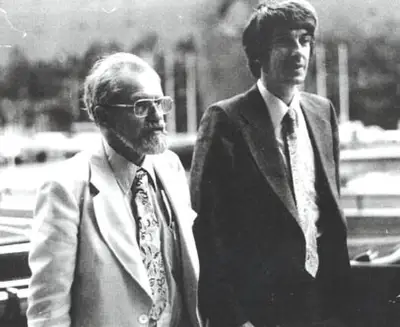
The investigator Jennie Zeidman, who had worked as the personal assistant of the astronomer J. Allen Hynek, studied the case in depth for the Center for UFO Studies and published her report, "Helicopter-UFO Encounter Over Ohio", in 1979. She reconstructed the event second by second and calculated that the object was in the crew's view continuously for at least five minutes — which, with the descriptions from the air and the ground, she and other supporters argue rules out a meteor. The case was also discussed in the Flying Saucer Review, the International UFO Reporter and the proceedings of MUFON's 1989 symposium.[3][4]
The crew's reports varied on some points; estimates of how long the unexpected climb lasted range from one to four minutes. According to Brian Dunning, UFO sightings were all the rage in the Mansfield and Ashland area that month: from two days before the incident, local newspapers reported sightings for about three weeks. On 23 June 1974 the tabloid National Enquirer awarded Coyne and his crew $5,000 for the year's best UFO story.[4]
Explanations
A meteor
The first detailed skeptical explanation came from Philip J. Klass, senior editor of Aviation Week & Space Technology, who devoted two chapters of his 1983 book UFOs: The Public Deceived to the case. He suggested the first red light was an ordinary aircraft and that a bright fireball from the Orionid meteor shower, active that month, then streaked in, prompting Coyne to dive; since the distance of a single bright light cannot be judged, a fireball far above could seem close and could light the cabin green. Klass noted that no fireballs were reported to the American Meteor Society from Ohio that night. Dunning thought the meteor could explain part of the event but was too minimal to account for the rest, and supporters reply that a meteor could not stay in view for minutes or explain the ground witnesses.[3][4]
A refuelling tanker
In 2018 an anonymous blogger writing as "Parabunk" proposed that the first red light was the wingtip light of an aerial refuelling tanker flying the other way, which circled behind the helicopter and came up on its right, then moved ahead and above it in a standard NATO rendezvous manoeuvre. When the Huey failed to take up a refuelling position, the tanker switched on a powerful spotlight to identify it — the green illumination — then veered off west, and the helicopter flew through its wake, explaining the bump. Parabunk suggested an HC-130P, a C-130 variant built to refuel helicopters at low speed. Dunning found the idea fundamentally sound but noted it was entirely without evidence: no documentation shows such a spotlight on the HC-130P, no C-130s were assigned to the Ohio Air National Guard in 1973 (the nearest were at Selfridge in Michigan), and the local Ohio KC-97L tankers could not refuel helicopters and never flew that low. Hueys could not be refuelled in flight, so the crew would have had no idea what such a manoeuvre looked like.[4]
The climb
Dunning saw nothing mysterious in the climb. Hueys of the time had no autopilot and are sensitive to the controls, so a distracted, possibly dazzled and disoriented pilot could easily climb without noticing. Jezzi himself later told Zeidman that a helicopter climbs easily if the pilot is excited and not paying attention, and that going from about 1,500 to 3,000 feet in two or three minutes was not extraordinary — it had happened to him.[4]
Hoax
Dunning also kept a hoax on the table, though he thought it unlikely: four young men on a routine night flight with an expensive helicopter, a local UFO craze in the papers, and a tabloid prize that they did in fact win. He concluded that an honest misidentification of ordinary lights, probably different unrelated aircraft, combined with disorientation, was most likely, but that there was not enough information to settle the case.[4]
Legacy
The Coyne incident put north-central Ohio on the UFO map and is still regarded by many as one of the most credible encounters on record, largely because of the crew's standing. Local media have reported at least eight other UFO stories in the Mansfield area since 1948, including a strange light seen by Olive Owen near Possum Run Road in March 1948.[2]
References
- Army Disposition Form, "Near Midair Collision with UFO Report" (23 Nov 1973), transcribed by Patrick Gross · ufology.patrickgross.org · archived copy
- Taylor Perry, "Out of this world: Coyne Incident focused UFO attention on north central Ohio in 1973", Richland Source (29 April 2022) · richlandsource.com · archived copy
- Patrick Gross, "The Coyne case, Mansfield, Ohio, 1973", UFOs at close sight · ufology.patrickgross.org · archived copy
- Brian Dunning, "The 1973 Mansfield UFO Encounter", Skeptoid #1057 (Sept 2026) · skeptoid.com · archived copy
🛸 Sightings & submissions about this 5
 My Dad Was 50 Feet From A Flying SaucerMeldahl Dam
 Possible UFO/UAP sighting in Cleveland OH 3-15-22 @ 7:30 AMMar 15, 2022 · Cleveland
 Looking into the Cincinnati, Ohio skyline there's something above the city.Cincinnati
 The Coyne UFO Incident - 1973, Helicopter is lifted from 1700ft to 3500ft in seconds
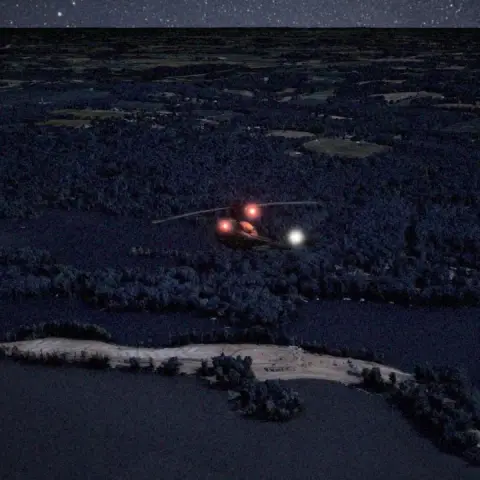 The Coyne Incident (1973) technical recreationOct 18, 1973
This page was last edited on 31 October 2026. Articles are written in our own words from the sources listed under References; disputed claims are attributed to the people who made them.
No discussion yet.