Cussac close encounter
From the UAP Encyclopedia, the open encyclopedia of UFO and UAP history · 🛸 Case
Contents 8
Summary
Two children in Cussac, France, reported seeing four small figures next to a shining sphere that flew away on the morning of August 29, 1967. Official investigators such as GEPAN interpreted the event as the departure of an occupied unknown vehicle, while skeptical researchers argued the children likely saw a brief helicopter landing.

| Type | Case |
|---|---|
| Also known as | Rencontre de Cussac |
| Date | About 10:30 a.m., 29 August 1967 |
| Place | Les Tuiles, about 800 m west of Cussac, Cantal, France |
| Witnesses | François Delpeuch (13½) and his sister Anne-Marie (9) |
| Investigators | GEPA (1968), LDLN, GEPAN (1978), Pinvidic et al. (1983–85), Éric Maillot (1996–99) |
The Cussac close encounter (French: rencontre de Cussac) is the report by two children that on the morning of 29 August 1967, while tending cattle near the village of Cussac in the Cantal department of France, they saw four small dark figures beside a shining sphere, which then rose into the sky and flew away. The children told their father, the village mayor, and the gendarmerie, and the case was reported in the French press.[1][3]
It became as famous in France as the Kelly–Hopkinsville encounter in the United States, and is one of the cases investigated by GEPAN, the French space agency's UFO unit, which in 1978 interpreted it as the departure of an occupied vehicle of unknown type. Skeptical investigators argue that the children most likely saw a light helicopter landing briefly, its description later embellished by the press and by years of retelling.[1][2][3]
The setting
In 1967 Cussac was a village of 282 people in 70 houses, on a plateau at 1,045 metres. The morning of 29 August was fine and clear but a little cool, at 12 to 16 °C, with a light westerly breeze; in two valleys about 10 km away there was morning fog. According to Éric Maillot's later research, the area had been used as a military exercise zone for three years.[3]
The encounter
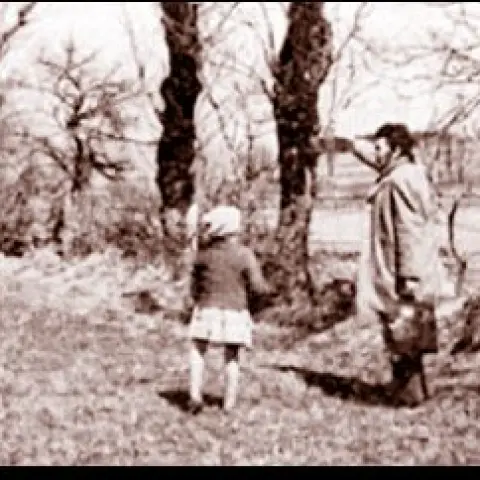
From 8 a.m. François Delpeuch, aged thirteen and a half, and his sister Anne-Marie, aged nine, with their dog Médor, had been minding about ten of the family's cows in a meadow at a spot called Les Tuiles, about 800 metres west of the village, beside the D57 road between Les Ternes and Pont-Farin.[3]
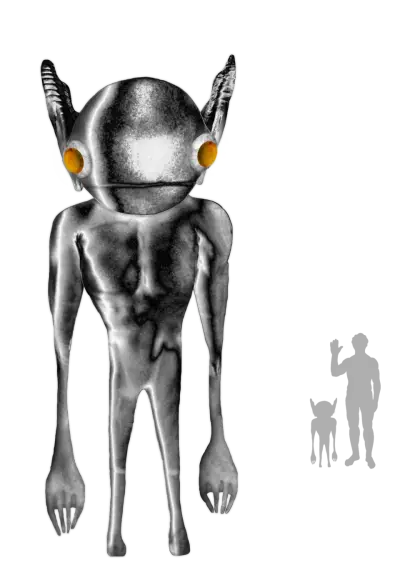
According to the account in the regional daily La Montagne of 1 September 1967, at about 10:30 they suddenly saw four small "dwarfs" beyond a roadside hedge. The figures ran behind the bushes, and François climbed onto a wall to see them better. He saw a shining object, about 60 metres away, so bright it dazzled him. The figures seemed to wear black suits and to have hair on their faces; they dived head first into the craft, which the paper described as about 4 metres wide and 2 metres high. Anne-Marie saw one come back out as if it had forgotten something. Then the craft rose and quickly disappeared into the sky. The children described it as reflective or metallic before it became intensely luminous as it left, with a whistling sound.[1][3]
Their account was heard by their father, M. Delpeuch, who was the mayor of Cussac, by the acting commander of the gendarmerie company at Saint-Flour, whom he alerted, and by La Montagne's correspondent. A gendarme who arrived just after the incident noted a strong smell of sulphur. A farmer on a tractor who passed the children afterwards confirmed they were in a state of panic.[3]
Early investigations
In April 1968 Joël Mesnard and Claude Pavy investigated for the civilian Groupe d'Étude des Phénomènes Aériens (GEPA). Their report, published in Phénomènes Spatiaux in June 1968, presented the children's testimony with drawings and a photograph of the site; Mesnard's illustrations showed two figures, the sphere, and its departure on a spiral path. The UFO association Lumières Dans La Nuit (LDLN) also investigated.[1][3]
In 1977 Luc Bourdin of LDLN met François Delpeuch, then a student at Clermont, and carried out a complete re-investigation. He learned that the line attributed to the children — inviting the figures to come and play — was a journalist's invention, since they had quickly realised they were not dealing with other children. François also said he had not seen any "legs" under the sphere; only his sister had mentioned that detail.[3]
The GEPAN investigation
In April 1978, more than ten years after the event, investigators from GEPAN — the Groupe d'Étude des Phénomènes Aérospatiaux Non Identifiés, set up by the French space agency CNES and directed by Claude Poher — carried out a retrospective field investigation at Cussac with François and Anne-Marie. They interviewed the original witnesses and others whose observations they thought related, took measurements at the site, and tried to reconstruct the event. They reviewed the reports of an unusual smell but did not establish its composition or origin. GEPAN concluded that the reconstruction confirmed the children's credibility, interpreted their account as indicating "the departure of an occupied vehicle of unknown type", and rejected the helicopter explanation.[1][3]
GEPAN's 1978 report was not made public at the time. A redacted version was released in March 2005, after efforts by the French researcher Grégory Gutierez and with the agreement of CNES, and in 2026 the Sign Oral History Project published an English translation with the original French document and a historical introduction. The conclusion that the children were credible was also cited in the COMETA report.[1][3]
Later investigations
Between 1983 and 1985 Thierry Pinvidic, Bertrand Méheust and Jean-Pierre Grangeon re-interviewed the witnesses and compared the original and later accounts. François told them the object had been unbelievably bright, that he had felt heat and a blast of air, and that he thought he had experienced a "distortion" of time. They questioned the reliability of some details, including the duration, the descriptions of the figures and the alleged ground traces, without agreeing on an explanation, though Pinvidic judged the helicopter hypothesis "indefensible". In 1990 he published a study of the case in the journal Communications, in an issue on contemporary rumours and legends, examining the links between unusual experiences, witnesses' memories and the cultural framing of UFO stories.[1][3]
The skeptical re-examination
Between 1996 and 1999 Éric Maillot, for the skeptical Cercle Zététique, reopened the file and recovered almost all the original documents, including those used by GEPAN in 1978. He concluded that the children had indeed seen something, probably a military vehicle, since the area had been an exercise zone; that it was probably not French, as French archives recorded no such movement; and that, in the absence of evidence for a "close encounter of the third kind", the simplest credible explanation was a helicopter that landed for a few moments. An Alouette II helicopter from a base at Bordeaux often flew over the area, but no precise records of its flights could be found. Some ufologists objected that the children did not describe any doors closing, nor would a helicopter's passengers have looked so strange.[1][3]
In a 2009 Skeptical Inquirer review of thirty years of French official UFO studies, David Rossoni, Éric Maillot and Éric Déguillaume argued that the reported shape, noise and manner of take-off at Cussac were consistent with a light turbine-powered helicopter, probably an Alouette II, and that GEPAN had rejected this without even minimal investigation. They also criticised the decision to investigate eleven years after the event — against the advice of GEPAN's own scientific council — and argued that the children's successive accounts multiplied new elements within only a few months, raising their story "to the realm of fantasy".[2]
Press coverage
The skeptics also criticised how regional media handled the story, rewording and amplifying the children's account to make it more sensational, and suspected that investigators influenced the young witnesses through leading questions and demands for precise details of brief moments. François Delpeuch, reflecting on the shock he suffered in 1967, has maintained his statements in full.[3]
References
- Close encounter of Cussac — Wikipedia · en.wikipedia.org · archived copy
- David Rossoni, Éric Maillot and Éric Déguillaume, Skeptical Inquirer (2009) (PDF) · skepticalinquirer.org · archived copy
- Rencontre de Cussac — Wikipédia (in French) · fr.wikipedia.org
Facts in this article are drawn in part from the Wikipedia articles “Close encounter of Cussac”, “Rencontre de Cussac — Wikipédia (in French)”, available under the CC BY-SA 4.0 licence.
🛸 Sightings & submissions about this 1
This page was last edited on 31 October 2026. Articles are written in our own words from the sources listed under References; disputed claims are attributed to the people who made them.
No discussion yet.