Twin Falls saucer hoax
From the UAP Encyclopedia, the open encyclopedia of UFO and UAP history · 🛸 Case
Contents 6
Summary
The Twin Falls saucer hoax was a fake flying disc planted in a yard in Twin Falls, Idaho, on July 11, 1947. Four teenage boys built and placed the homemade device as a prank, causing local police, the FBI, and Army intelligence officers to investigate it. The boys confessed the same day, resulting in no charges and helping bring an end to the press coverage of the 1947 saucer craze.

| Type | Case (hoax) |
|---|---|
| Date | Planted about 10–10:30 p.m., 10 July 1947; found 8:20 a.m., 11 July 1947 |
| Place | Yard of the Thompson residence, Twin Falls, Idaho |
| Object | Disc 30½ inches (77 cm) across, with Plexiglas and metal domes, radio tubes and wires; painted gold and silver |
| Investigators | Twin Falls police; FBI (Guy Banister, Butte office); Army intelligence from Fort Douglas, Utah |
| Hoaxers | Four boys aged 15–16 (unnamed) |
| Outcome | Confession the same day; no charges |
| Also known as | Twin Falls hoax |
The Twin Falls saucer hoax was a fake "flying disc" found in a yard in Twin Falls, Idaho, on the morning of 11 July 1947, at the height of the first American flying-saucer wave. The homemade object, about 30 inches across, sent local police, the FBI and Army intelligence officers flown in from Utah scrambling to work out what it was. By that evening, four teenage boys had admitted building it as a prank. The nationally published photograph of a bemused Army officer holding the disc has been called the "coup de grâce" of press coverage of the 1947 saucer craze.[1][2][3]
Background

On 24 June 1947 the civilian pilot Kenneth Arnold reported "flying discs" near Mount Rainier, and by 27 June sightings were being reported across the country. On 1 July the Twin Falls Times-News declared that "flying saucers have invaded" the region. A forest ranger and his companion, marking timber about three miles south of Galena Summit, said they heard a buzzing overhead and saw eight to ten shining "discs" in a V formation. One of them, Walter Nicholson, said "it wasn't anything like an airplane". On 2 July Mr. and Mrs. J. F. Meuser reported a "big ball of fire" the size of the Moon but much brighter near Malta, Idaho. On 3 July a railway foreman, B. G. Tiffany, said he and his crew had seen nine discs flying silently in a V over Hollister a month before. On 4 July a Twin Falls resident, R. L. Dempsey, reported two discs over the city, and three Richfield residents reported one.[1]
On 5 July a group of 60 picnickers reportedly watched 35 discs over Twin Falls. The local press called it the "largest number of the mystery devices reported anywhere in the nation". On 7 July three boys aged 14 and 15 were named as witnesses of a single disc "the size of a motor scooter wheel". The Twin Falls disc was not the first "recovered" saucer. On 8 July the Army at Roswell, New Mexico, announced it had a "flying disc", explained the next day as a weather balloon. On 10 July United Press reported a hoax saucer supposedly recovered in North Hollywood.[1]
The disc

Residents of the neighbourhood later said they had heard a "thud" at about 2:30 a.m., but had dismissed it as a truck. At 8:20 a.m. on Friday 11 July, Mrs. Fred Easterbrook found a disc in the yard of the neighbouring Thompson residence (the AP gave the owner's initials as T. H., the Los Angeles Times as M. H.) and called the police. Two narrow strips of turf on the lawn were torn up, as if the disc had ploughed into the ground. Officers were puzzled how a metal object could have dropped through the maze of telephone and power wires overhead.[1][3]
The disc measured 30½ inches (77 cm) across and resembled two band cymbals put together, or the base of an old-fashioned chandelier. It had a Plexiglas dome about 14 inches high on one side and a metal dome on the other, held on by what looked like stove bolts. Inside the plastic dome were three silver-painted radio tubes, with wires leading to what looked like an electromagnetic coil on the outside, and burned wires. One side was painted gold and the other silver, and the object looked as if it had been machine-made.[1][3]
Investigation

The local police took possession of the object and referred the matter to the FBI and military intelligence. An FBI agent took one look and notified his district office in Butte, Montana. Shortly after noon, a Utah National Guard plane brought a party from Fort Douglas, Utah: two lieutenant colonels, two first lieutenants and a civilian. They refused to give their names and kept away from persistent reporters. Authorities "clamped down a lid of secrecy pending the outcome of further investigation", and the local press reported Army "cloak and dagger" activity, including the confiscation of photographs of the object. The FBI's special agent in charge, Guy Banister, reported that the object had been handed over to the Army. While speculation was at its height, the Army party slipped away from police headquarters with the disc, which was about the size of a bicycle wheel, and flew back to Salt Lake City.[1][3]
Confession
Shortly after the Army's departure, Assistant Police Chief L. D. McCracken announced that it was a hoax. He said four boys aged 15 to 16 had admitted it after he was tipped off that one of them "knew something about the case". They said they had spent two days building the disc from parts of an old phonograph, burned-out radio tubes and other discarded electrical parts. They said they had planted it in the Thompsons' yard at about 10 p.m. the evening before. A Salt Lake City paper gave the time as 10:30 p.m. McCracken withheld their names because they were juveniles, and no court action was taken.[1][3]
According to the Associated Press, an FBI agent then came into McCracken's office in front of reporters and asked whether he had "released the news". "What news?" McCracken replied. The agent said that Army intelligence had cleared him to tell the press that four teenage boys had confessed to making the object and throwing it into the yard. McCracken then told the whole story. The AP summed up the day: the boys had skimmed a "flying saucer" into town, and before their admission that it was "all a joke", the FBI, Army intelligence and local police "spent a dizzy day trying to figure out their gadget". On 12 July the hoax was reported nationally, and photographs of the disc were released.[1][2][3]
Significance

The widely printed photograph of a bemused Army officer holding the homemade disc has been called the final blow to press coverage of the 1947 saucer craze. In the following days, "press accounts rapidly fell off". On 15 August 1947 the Times-News reflected that the nation had become so "flying saucer" conscious that four teenage boys caused "a mild sensation" with their model disc. After it, reports had tapered off to a few scattered incidents until new sightings that week revived the question. The Twin Falls hoax was not the last. On 28 July 1947 came reports of disc debris on Maury Island, Washington, and in 1949 the Aztec, New Mexico, crashed-saucer hoax.[1][4]
Banister, the FBI official who had overseen both the Twin Falls and Maury Island cases, was posthumously accused in the late 1960s of involvement in the assassination of John F. Kennedy. The accusation came from the New Orleans district attorney Jim Garrison and was dramatised in the 1991 film JFK. Fringe conspiracy writers including Kenn Thomas, Nick Redfern and Peter Lavenda have since linked the two saucer cases to both UFO and Kennedy assassination theories.[1]
References
- Twin Falls saucer hoax — Wikipedia · en.wikipedia.org · archived copy
- "July 11, 1947: Twin Falls UFO Hoax", Museum of Hoaxes · hoaxes.org · archived copy
- "Army, FBI, Police in Circles Hoax With Galloping Disc Admitted By Idaho Youths", Associated Press, 11 July 1947 (reprinted by Project 1947) · project1947.com
- "Heads up, folks! The disks are flying again", Times-News (Twin Falls), 15 August 1947 (reprinted by Patrick Gross) · patrickgross.org
Facts in this article are drawn in part from the Wikipedia article “Twin Falls saucer hoax”, available under the CC BY-SA 4.0 licence.
🛸 Sightings & submissions about this 3
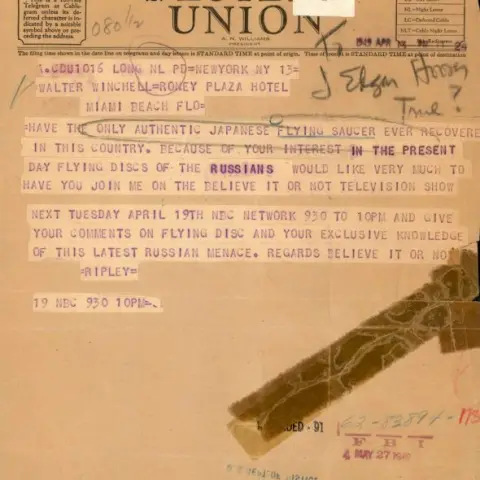 Letter From Ripleys to J Edgar Hoover on recovered saucer
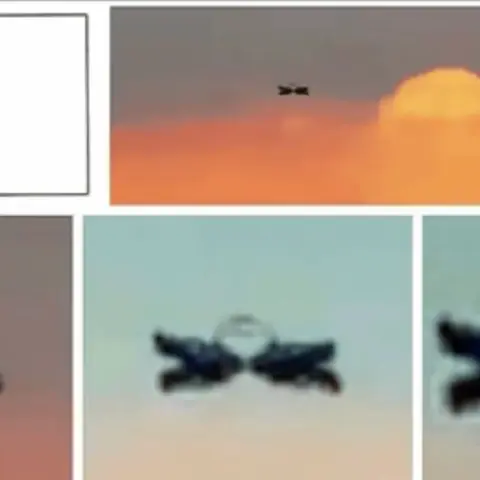 More photos of UFOs from Weibo. I notice a few similar shapes to what we may see in the West, but there is some unusual ones as well. The bubble ones are also weird and so are the shockwave portal…
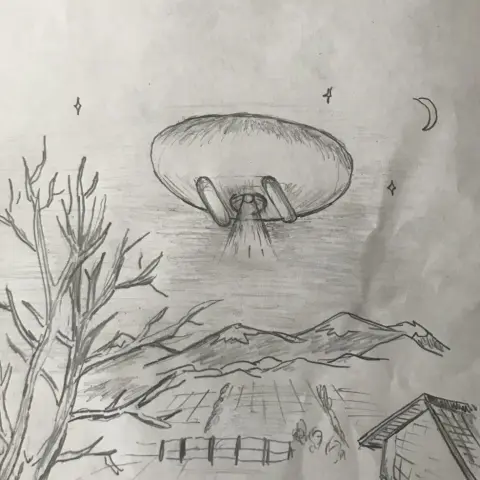 UFO sighting. Twin Falls, Idaho. Artistic Representation I did for the friend who saw it. Seen early morning of 1/7/2020.Jan 7, 2020 · Twin Falls
This page was last edited on 31 October 2026. Articles are written in our own words from the sources listed under References; disputed claims are attributed to the people who made them.


No discussion yet.