1561 celestial phenomenon over Nuremberg
From the UAP Encyclopedia, the open encyclopedia of UFO and UAP history · 🛸 Case
Contents 11
Summary
The 1561 celestial phenomenon over Nuremberg was an atmospheric display that occurred at dawn on April 14, 1561, in Nuremberg, Holy Roman Empire. According to an illustrated broadsheet by Hans Glaser, many people witnessed colored balls, crosses, and rods appearing to fight in the sky before falling to the ground in smoke. While modern ufologists have claimed this was an extraterrestrial battle, historians and skeptics view the event as a religious warning based on natural atmospheric phenomena like sun dogs.

| Type | Case |
|---|---|
| Also known as | Nuremberg 1561, Nuremberg broadsheet, "Nuremberg UFO battle" |
| Date | 14 April 1561, at dawn |
| Place | Nuremberg, Holy Roman Empire (now Germany) |
| Known from | Illustrated broadsheet by Hans Glaser |
| Held by | Zentralbibliothek Zürich |
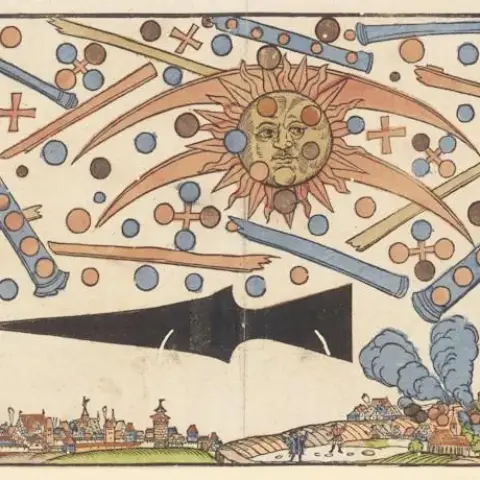
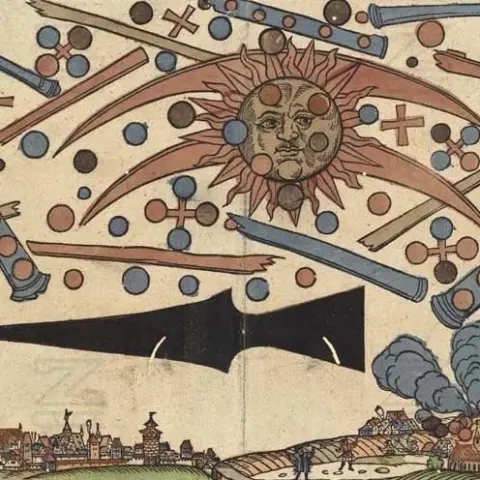
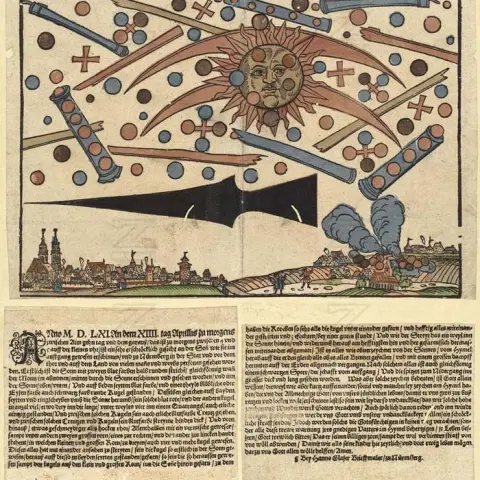
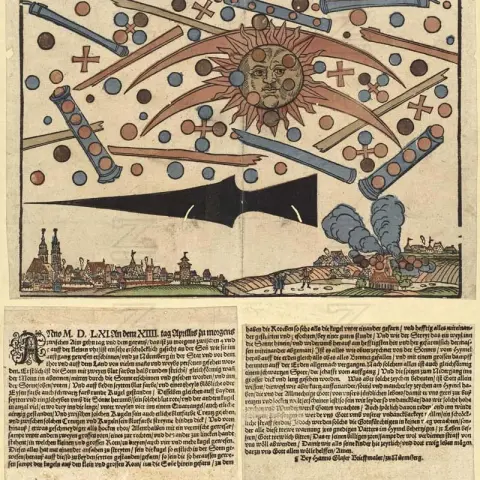
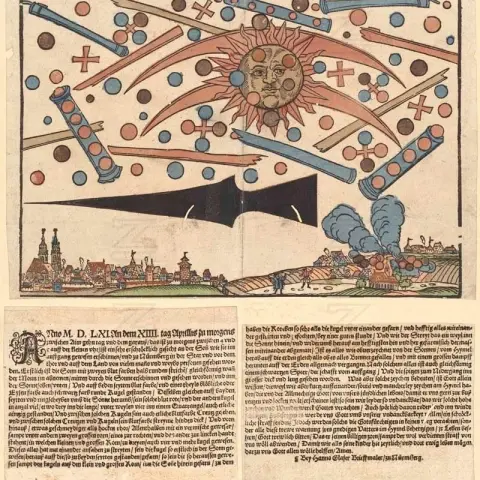
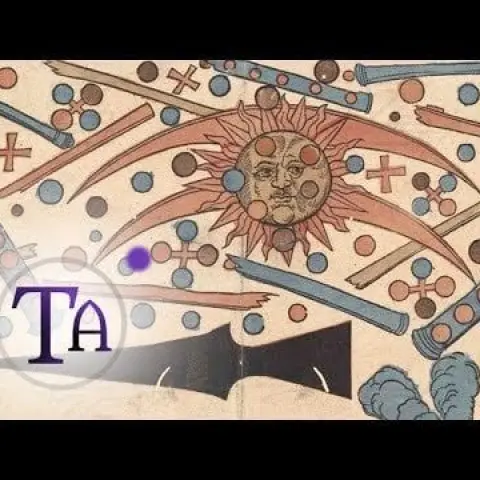
The 1561 celestial phenomenon over Nuremberg is a display in the sky that, according to an illustrated broadsheet printed that April, was seen at dawn on 14 April 1561 by many people in and around Nuremberg, then a Free Imperial City of the Holy Roman Empire. The broadsheet, written and illustrated by Hans Glaser, describes blood-red arcs, crosses, rods and great numbers of coloured balls that seemed to fight one another in and around the sun for more than an hour before falling to the ground in smoke, followed by the appearance of a long black spear.[1]
The woodcut that accompanies the text has been reproduced many times in books about UFOs, and some ufologists and ancient-astronaut writers have presented it as a record of an aerial battle between extraterrestrial craft. Skeptics and historians regard it as a religious warning built around an atmospheric display, most likely sun dogs and related halo effects, drawn by an artist working from other people's descriptions.[1][2]
The broadsheet

The source of the story is a single printed sheet, a form of early news publication, illustrated with a woodcut and with text by Hans Glaser, who signed himself a "letter-painter" of Nuremberg. The sheet measures 26.2 by 38.0 centimetres. It survives in the prints and drawings collection of the Zentralbibliothek Zürich, the central library of Zürich in Switzerland.[1]
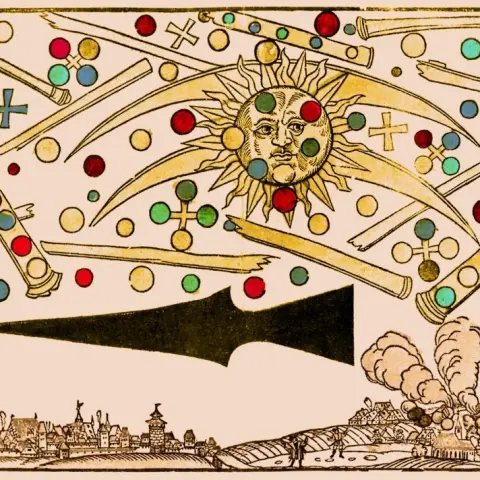
The woodcut shows objects of many shapes over a landscape: crosses, some with balls on their arms; many small spheres; two large crescents; a black spear; and tube-like shapes from which several small spheres seem to emerge.[1] According to Jason Colavito, the woodcut was made after the event from witnesses' descriptions rather than from the artist's own observation.[2]
What the broadsheet describes

An English translation of the text was made by Ilse von Jacobi. According to it, the "dreadful apparition" began at daybreak on 14 April 1561, between 4 and 5 o'clock in the morning, and was seen in the city of Nuremberg, before its gates and in the surrounding countryside by many men and women.[1]
First, two blood-red half-circle arcs appeared in the middle of the sun, like the moon in its last quarter. The sun itself was blood-coloured above, below and on both sides, and a round ball of a dull, partly black, iron-like colour stood in it. On both sides of the sun, and in a ring around it, stood more blood-red balls and others in great numbers — some three in a row, some four in a square, some alone.[1]
Between the balls were a few blood-red crosses, with blood-red strips between them that grew thicker towards the back and were flexible at the front, like reed stalks, and that were tangled together. Among them were two large rods, one on the right and one on the left, and inside the small and large rods were three, four or more balls.[1]
All of these, the text says, began to fight among themselves. The balls that had been in the sun flew out to those on either side, and the balls outside the sun, in the rods, flew into it; the balls also flew back and forth and fought fiercely for more than an hour. When the struggle was at its height, they grew so tired that they all fell from the sun to the earth as if they were burning, and wasted away on the ground in a great deal of smoke. Afterwards something like a black spear, very long and thick, was seen, its shaft pointing east and its point west.[1]
Later retellings have added to the description, speaking of a large black triangular object and of hundreds of spheres, cylinders and other odd shapes moving erratically overhead.[1]
The moral
Most of the remaining text is a sermon. Glaser writes that only God knows what such signs mean, that many signs had recently been sent from heaven to bring people to repentance, and that people ungratefully mocked or ignored them. He urges the God-fearing to take the sign as a warning from a merciful Father, mend their lives and pray that God will turn away his anger and the punishment they deserve.[1]
Similar events and images

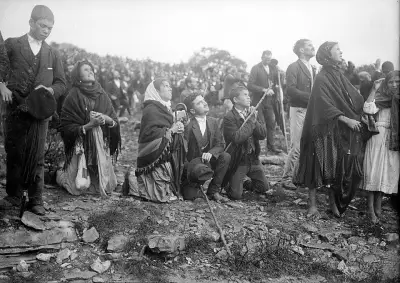
The Nuremberg sheet is one of a number of sixteenth- and seventeenth-century accounts of strange sights in the sky. Others include the halo display over Stockholm in 1535, painted in the Vädersolstavlan ("sun-dog painting"); a "miracle sign" over Waldeck Castle near Kemnath in the Upper Palatinate in 1554, also published by Hans Glaser; the Plech sky spectacle in Germany in the same year; the 1566 celestial phenomenon over Basel; a meteorite at Hatford in Oxfordshire in 1628; and the 1665 celestial phenomenon over Stralsund. The 1917 Miracle of the Sun at Fátima in Portugal is also often compared with it.[1]
Interpretations

Carl Jung
The broadsheet became widely known outside Germany after the psychologist Carl Jung reproduced it in his 1958 book Flying Saucers: A Modern Myth of Things Seen in the Skies, which examined the symbolic meaning of UFO sightings. According to Colavito, this appears to have been the first time the image was linked with UFOs — an irony, since Jung used it to argue that UFOs were a myth arising from the unconscious rather than physical craft.[1][2]
Jung thought the spectacle was most likely a natural event, interpreted through the religious and military imagery familiar to sixteenth-century Europeans, though his main interest was its symbolism and he discussed explanations only in passing. He remarked that if UFOs were living things, one would expect a swarm of insects rising with the sun to mate rather than to fight. He suggested that the groups of four balls joined by lines represented "marriage quaternities" and a model of cross-cousin marriage — a use of the symbol for which there is no evidence, and which may reflect the kinship charts of modern anthropology. He also saw in the woodcut a possible symbol of individuation, and in its link with sunrise a revelation of light.[1]
The religious-studies scholar Jeffrey J. Kripal has discussed how Jung, by reprinting the image, unintentionally supplied material for later ancient-astronaut writers.[2]
Ufology and ancient astronauts
In ufology the broadsheet is often cited as evidence that extraterrestrials visited Earth in earlier centuries, with the descriptions of "fighting" taken literally as a battle between craft. The image has appeared in the Weekly World News, in the television series Ancient Aliens and in Graham Hancock's book Supernatural, where Hancock suggested it might reflect a mass hallucination caused by a drug. Colavito traces the ancient-astronaut versions of the story back to a claim by Erich von Däniken that later writers copied from one another.[1][2]
The ufologist Jacques Vallée was skeptical. Because the Nuremberg account closely resembles other near-identical sky events in sixteenth-century Europe, he suggested it might be a "stock myth" spread, and perhaps commissioned, by religious authorities, and he read the warnings and end-of-the-world tone of Glaser's text as signs that its purpose was propaganda.[1]
Sun dogs and halo displays
Frank Johnson, writing on the blog Ancient Aliens Debunked, compared an English translation of the text with known atmospheric phenomena and concluded that the woodcut is a second-hand picture of an unusually elaborate display of sun dogs — bright spots and arcs produced when sunlight passes through ice crystals in the atmosphere. Such displays can produce the arcs seen in the woodcut, as well as coloured spots and dark, angular lines. He also collected other sixteenth-century broadsheets that showed known sky phenomena in similarly strange ways, such as a "rain of fire" that represented an aurora, and argued that the Nuremberg image fits that tradition.[2]
Sun dogs and related halos had been known since antiquity and had been painted in Europe with geometric accuracy before Glaser's broadsheet, most famously in the Stockholm Vädersolstavlan. Historians point to the contrast between that painting and Glaser's abstract, mass-produced picture as evidence of what the broadsheet was for.[1]
Historians' view
The skeptic and historian Ulrich Magin questions whether the woodcut can be read as a faithful picture of the event at all. He points out that Nuremberg Castle, the city's defining landmark, is missing from it, while the Church of St. Leonhard appears even though that church had burned down by the time of the sighting.[1]
Magin and other skeptics, including Wiebke Schwarte, conclude that broadsheets like Glaser's were religiously themed popular reading, closer to tabloid news than to a truthful record. Literacy in Nuremberg at the time is estimated at about 30 per cent among men and close to nothing among women, and readers may well have understood that such sheets were not meant to be taken as literal reports.[1]
A Christian interpretation
Some writers have compared the Nuremberg display with the Miracle of the Sun at Fátima in 1917. The priest and physicist Stanley L. Jaki, who held doctorates in both theology and physics, proposed a meteorological explanation for Fátima: a sudden temperature inversion that moved a lens of air laden with ice crystals, which refracted the sun's light. He argued that such an explanation need not contradict Catholic teaching, holding that God often works through a natural basis while greatly enhancing it.[1]
References
- 1561 celestial phenomenon over Nuremberg — Wikipedia · en.wikipedia.org
- Jason Colavito, "The UFO Battle over Nuremberg" (12 December 2012) · jasoncolavito.com
Facts in this article are drawn in part from the Wikipedia article “1561 celestial phenomenon over Nuremberg”, available under the CC BY-SA 4.0 licence.
🛸 Sightings & submissions about this 23
 Do Historical “Sky Battles” Resemble Modern UAP Reports? A Source-Critical Study of Nuremberg 1561, Basel 1566, Stralsund 1665, and the PURSUE FilesNuremberg
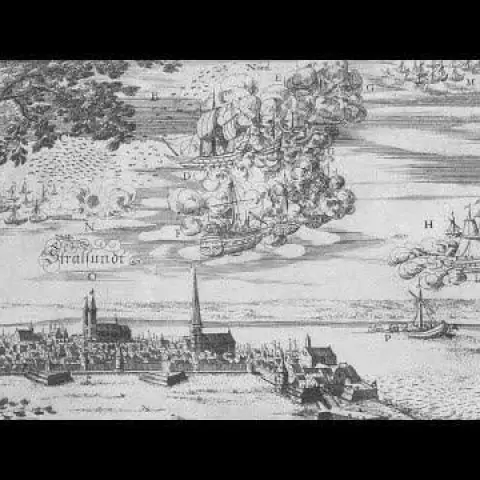 "An Illustrated Description of the Wondrous Airborne Wars and Ship-Fights of Stralsund" (1665) - my own translation, complete with the original diagramStralsund
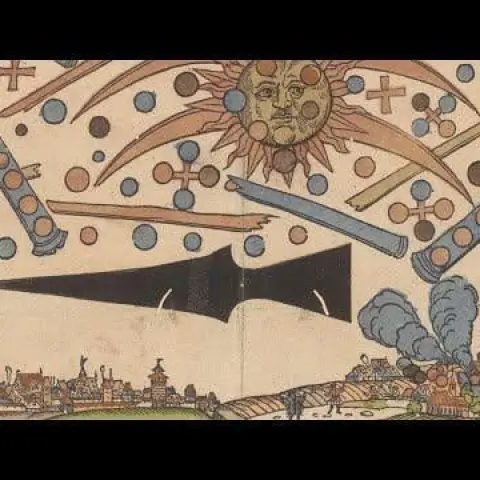 My translation of the 1561 print about the celestial phenomenon over NurembergNuremberg
 Was the 1561 celestial phenomenon was an alien invasion?Nuremberg
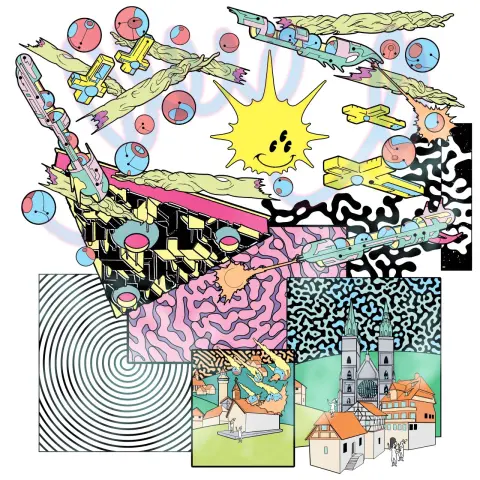
 I believe this is what’s going down. We have Orbs shooting from craft. X shaped drones and batwing stealth flying high on the sky (2 covering sun). Just waiting for the huge black spade to show up…Nuremberg
 Looks kinda... familiar now.New Jersey
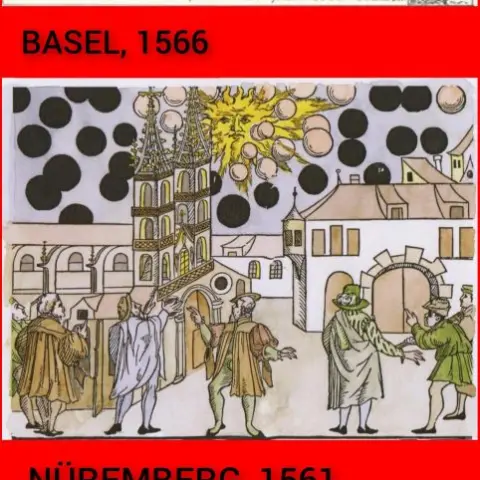 This Is An Event! And It Has Happened 3 Times Before In 3 Different Locations!Nuremberg
 1561 celestial phenomenon over NurembergNuremberg
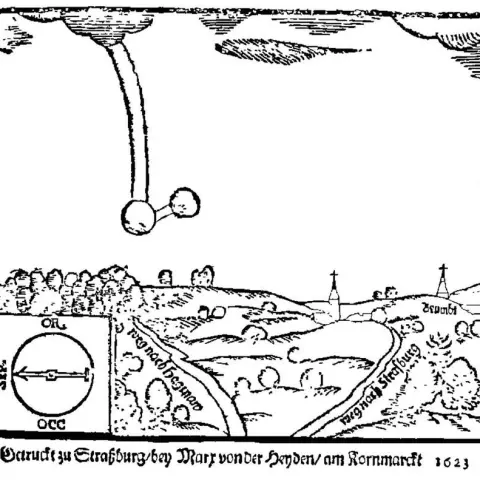 A story of astronomer and engineer of the first calculator Wilhelm Schickard and his egg or oval shaped UFO sighting in 1623. Also information about other sightings around that time period.Aug 27, 2024
 1561 Mass UFO sighting / UFO battle
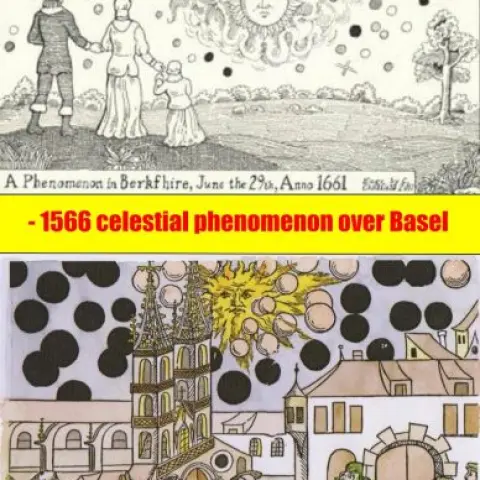 I have linked more than hundreds cases chronologically for you. From 1 CE to the present day. From all continents and countries.Nuremberg
 Early ufo sighting in Nuremberg modern day Germany in 1561 also posting translationNuremberg
 Karlsruhe 2023 similar to Nuremberg 1561Oct 1, 2023 · Karlsruhe
 Has this one been explained?
 Tweet from @tinyklaus: 'Ryan Graves says that pilots on routes crossing the Atlantic and Pacific Oceans have recently been reporting UFOs that look like they're "dogfighting in space."'
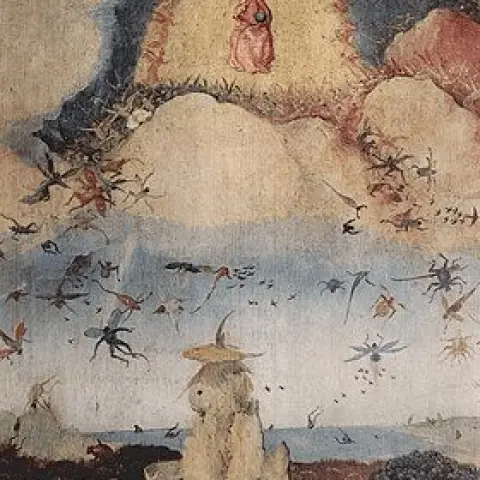 Mass Sightings in History, Important Events That Support One AnotherNuremberg
 Since the themes of the last week have been "motherships" and flying metallic spheres/balls, why not revisit the Nuremberg event on April 14, 1561?Nuremberg
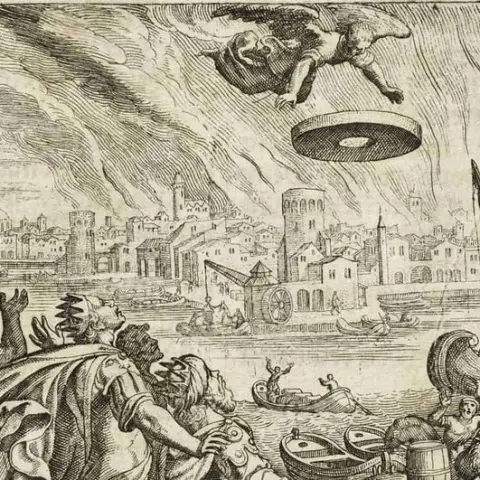 Did you know about the 1665 air battle of Stralsund?Berlin
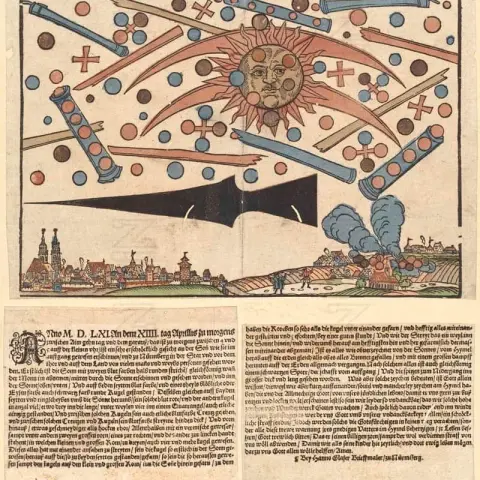 Celestial phenomenon in Nuremberg of 1561 The cylindrical UFOs are the most recorded since ancient timesNuremberg
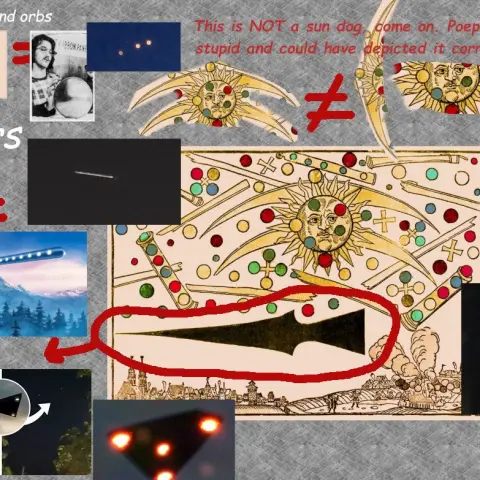 Not sure why it's even up for debate. Nuremburg 1561 incident.Nuremberg
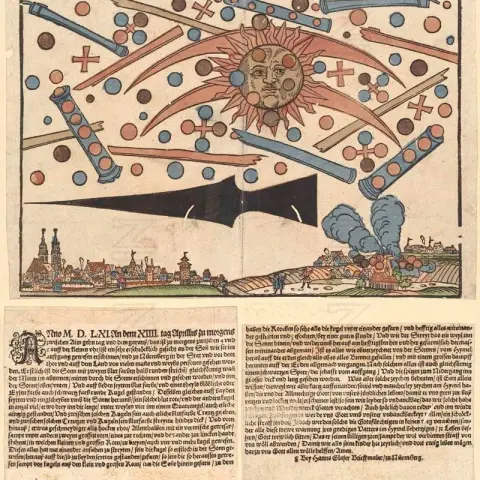 You ever heard of the 1561 Nuremberg Celestial Phenomenon? A reported incidence of a great space battle over Germany in the middle ages.Germany
 Is this the same kind of object as the battle at Nuremberg?Nuremberg
 UFOs over Nuremberg, 1561Nuremberg
This page was last edited on 31 October 2026. Articles are written in our own words from the sources listed under References; disputed claims are attributed to the people who made them.


No discussion yet.