Are aliens real?
From the UAP Encyclopedia, the open encyclopedia of UFO and UAP history · 🧭 Topic overview
Contents 11

| Type | Topic overview |
|---|---|
| Also known as | Do aliens exist? |
| Life elsewhere | Not yet found |
| Planets known | More than 6,000 beyond the Solar System |
| Official finding on UFOs | No verified evidence of alien technology (AARO, 2024) |
Are aliens real? As of 2026 there is no confirmed evidence of life anywhere beyond Earth, and no verified evidence that extraterrestrial beings or their craft have visited Earth.[1][2] Many scientists nonetheless think life elsewhere is plausible, given the enormous number of planets, and the search is more active than ever.[1][3] The question really has two parts — does life exist elsewhere? and has it come here? — and the answers to them are quite different.
Part 1: Is there life elsewhere?

The numbers
Hubble observations suggest there are nearly 2 trillion galaxies in the observable universe, and at least one in ten Sun-like stars is thought to have planets. Even if only one in a billion of those planetary systems supported life, there would be billions of inhabited systems.[1] Astronomers have confirmed more than 6,000 planets around other stars, many in the "habitable zone" where liquid water could exist on a planet's surface.[3] Being in that zone does not guarantee a planet is habitable, though — Venus lies in it and is an inferno.[1]
Life on Earth has adapted to almost every environment, from the deep crust to boiling vents, which suggests life elsewhere could be similarly tough. But how easily life starts is a separate and unanswered question.[1] The "Rare Earth" hypothesis argues that complex life depends on so many lucky circumstances — the Sun's place in the galaxy, the arrangement of the planets, Earth's particular features — that it may be very rare.[1]
Where scientists are looking
- Mars. Mars once had rivers and lakes and may have been habitable billions of years ago. No conclusive evidence of past or present life has been found.[4] Seasonal changes in methane have been measured, but methane can also be made by geology.[4] In September 2025 NASA announced that the Perseverance rover had found the best possible signs of ancient life on Mars to date, in rocks with ring-like iron-phosphate features resembling those left by early microbes on Earth; this is a potential sign of life, not proof.[4]
- Icy moons. Jupiter's moon Europa has a salty ocean beneath its ice in contact with a rocky floor, and Saturn's moon Titan has lakes and rain of liquid methane and a hidden water ocean.[1]
- Venus. Its surface is the hottest in the Solar System, but it interests astrobiologists as a planet that started out like Earth and went a different way.[1]
- Exoplanet atmospheres. Telescopes can look for "biosignature" gases. In 2025 researchers reported a controversial detection of dimethyl sulfide — a gas produced on Earth by life — on the planet K2-18b. It has not been accepted as evidence of life: follow-up studies found the signal could be produced by other molecules, by processing choices or by non-living chemistry, and its statistical significance is small.[5]
- Signals. SETI projects have listened for radio and laser signals since 1960 without a confirmed detection; the famous Wow! signal of 1977 was never heard again.[6]
Claims of discovering extraterrestrial life have a long history of being contentious or disproved. A NASA team led by David McKay reported that features in the Martian meteorite ALH84001 were best explained by ancient bacteria, but all of the evidence was eventually found to be explainable by non-biological processes.[1] In 2023 the astrobiology community agreed that a true biosignature must be something that can only be explained by life, with every plausible non-living explanation ruled out.[7]
Why haven't we heard from anyone?
The Drake equation, devised by Frank Drake in 1961, sets out the factors that determine how many communicating civilisations might exist in our galaxy, but most of its values are still unknown, so it cannot settle the question.[1] The Fermi paradox asks why, if civilisations are common, we see no sign of them. Proposed answers range from life being rare, to civilisations being short-lived, to the sheer size of the search space.[1]
Part 2: Have aliens visited Earth?

What UFO reports usually turn out to be
Most UFO reports have ordinary explanations once investigated — planets such as Venus, satellites such as Starlink trains, aircraft, balloons, drones, rocket launches and camera effects.[8] A small share stay unexplained, usually because there is too little information to analyse rather than because the information points to anything extraordinary.[8][9]
What official investigations found
The US government has looked at the question many times:
- Project Blue Book (1952–1969). The US Air Force collected 12,618 reports; 701 remained unexplained. It concluded that no UFO had been a threat to national security, that there was no evidence of technology beyond modern science, and no evidence that "unidentified" sightings were extraterrestrial vehicles.[10] See Project Blue Book.
- The Condon Report (1969). The University of Colorado study concluded that "nothing has come from the study of UFOs in the past 21 years that has added to scientific knowledge"; a National Academy of Sciences panel added that extraterrestrial visitation was "the least likely explanation".[11]
- ODNI (2021). The Office of the Director of National Intelligence's preliminary assessment of 144 military reports from 2004 to 2021 could explain only one with confidence, but it did not suggest an extraterrestrial origin.[12]
- NASA (2023). NASA's 16-member independent study team found no evidence that UAP have an extraterrestrial origin. Administrator Bill Nelson summed it up: "The NASA independent study team did not find any evidence that UAP have an extraterrestrial origin. But we don't know what these UAP are." The report called extraterrestrial life "the hypothesis of last resort" and said that "the data needed to explain these anomalous sightings often do not exist."[9]
- AARO (2024). The Pentagon's All-domain Anomaly Resolution Office reported in its historical review that it found no evidence that any US government investigation, academic research or official review panel had confirmed that any sighting represented extraterrestrial technology.[2]
The claims
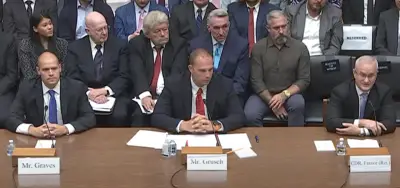
Since 2017 a series of former officials and witnesses — including Luis Elizondo and the former intelligence officer David Grusch, who told Congress in 2023 that the US runs a secret programme to recover "non-human" craft — have alleged a long-running government cover-up.[15] Congress has held several public hearings, and in February 2026 President Trump ordered federal agencies to identify and release government files on UFOs and extraterrestrial life; a first batch of about 162 declassified records was released on 8 May 2026, with more following.[13][14] No physical evidence of non-human craft or bodies has been made public. Grusch said he learned of the programme from others rather than seeing it himself.[15]
What the public thinks
In Gallup's July 2026 poll, 37% of Americans said at least some UFOs have been alien spacecraft, 49% said all sightings can be explained by human activity or natural phenomena, and 13% had no opinion. The share believing in alien spacecraft was 41% in 2021 and 33% in 2019; the main recent change has been a rise in people who are unsure. Seventeen per cent said they had personally seen something they thought was a UFO, and 78% said the government knows more than it is telling.[14]
The short answer

- Life elsewhere: unknown, but scientifically plausible and actively being searched for. No confirmed detection yet.[1]
- Aliens visiting Earth: no verified evidence. Most UFO reports are explained; the unexplained remainder is mostly a problem of missing data.[2][9]
See also: types of aliens, alien abduction, SETI, Fermi paradox, how to report a UFO.
References
- Extraterrestrial life — Wikipedia · en.wikipedia.org
- All-domain Anomaly Resolution Office (AARO) · aaro.mil
- Exoplanets — NASA Science · science.nasa.gov
- Life on Mars — Wikipedia · en.wikipedia.org
- K2-18b — Wikipedia · en.wikipedia.org
- Search for extraterrestrial intelligence — Wikipedia · en.wikipedia.org
- Biosignature — Wikipedia · en.wikipedia.org
- Unidentified flying object — Wikipedia · en.wikipedia.org
- "NASA UAP report finds no evidence of 'extraterrestrial' UFOs, but some encounters still defy explanation", CBS News (14 September 2023) · cbsnews.com
- Project Blue Book — Wikipedia · en.wikipedia.org
- Condon Committee — Wikipedia · en.wikipedia.org
- Preliminary Assessment: Unidentified Aerial Phenomena — Office of the Director of National Intelligence, June 2021 · dni.gov
- Pentagon UFO videos — Wikipedia · en.wikipedia.org
- "Americans Skeptical of UFOs Being Aliens", Gallup (2026) · news.gallup.com
- David Grusch UFO whistleblower claims — Wikipedia · en.wikipedia.org
Facts in this article are drawn in part from the Wikipedia articles “Extraterrestrial life”, “Life on Mars”, “K2-18b”, “Search for extraterrestrial intelligence”, “Biosignature”, “Unidentified flying object”, “Project Blue Book”, “Condon Committee”, “Pentagon UFO videos”, “David Grusch UFO whistleblower claims”, available under the CC BY-SA 4.0 licence.
This page was last edited on 14 November 2026. Articles are written in our own words from the sources listed under References; disputed claims are attributed to the people who made them.





No discussion yet.