Inertial mass reduction
From the UAP Encyclopedia, the open encyclopedia of UFO and UAP history · 📖 Term
Contents 8
Summary
Inertial mass reduction is a hypothetical technology proposed in a 2018 U.S. Navy patent by aerospace engineer Salvatore Pais to allow a vehicle to travel through air, water, and space at extreme speeds.

| Type | Term |
|---|---|
| Also known as | inertia reduction |
Inertial mass reduction is a hypothetical technology for reducing a vehicle's inertia so that it could accelerate and manoeuvre in ways otherwise impossible. It is best known from the 2018 U.S. Navy patent "Craft Using an Inertial Mass Reduction Device," filed by Navy aerospace engineer Salvatore Pais.[1][2] The patent described a "hybrid aerospace-undersea craft" able to cross air, water and space at extreme speed, and drew wide attention for resembling the UFOs reported by Navy pilots.[2] The Navy tested the underlying "Pais Effect" from 2016 to 2019 at a cost of $508,000 and concluded that it could not be proven. Physicists consulted by reporters said it had no scientific basis.[1][3]
Salvatore Pais

Pais, born in Romania in 1967, emigrated to the United States at about thirteen and earned a PhD in mechanical and aerospace engineering at Case Western Reserve University in 1999, with NASA-sponsored research on bubbles in microgravity.[1] He then worked at the Naval Air Warfare Center Aircraft Division (NAWCAD) at Naval Air Station Patuxent River in Maryland. He moved to the Navy's Strategic Systems Programs in June 2019, to the Air Force in January 2021, and later to the Space Force.[1][3] From 2015 he filed a series of Navy patents dubbed the "UFO patents." He said he began patenting "after rejections from academic publishing," accepted no royalties and acted from "pure patriotic duty."[1]
The patent

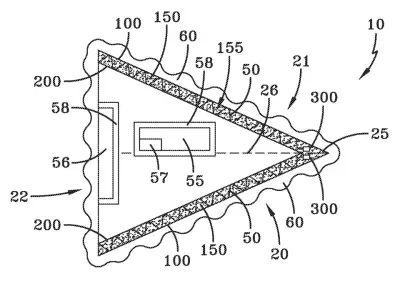
The application was filed on 28 April 2016.[2] It describes a craft able to "engineer the fabric of our reality at the most fundamental level."[1][2] The design and its claims:[2]
- The concept. By creating a dense, polarised energy field moving at very high speed, the craft would form a quantum "vacuum" around itself that repels air or water molecules, letting it ignore aerodynamic and hydrodynamic forces.
- Shape and components. The craft would be conical with an elliptical cross-section, "similar in geometry to a hypersonic glide vehicle." The drawings include microwave emitters, a xenon-filled resonant cavity, a rotating nose cone, a cargo bay and a crew compartment shielded by a Faraday cage.
- Performance. It would fly in air, water or space without a heat signature.
Rejection and appeal
The patent examiner, Philip Bonzell, rejected it on 30 March 2018, noting "there is no such thing as a 'repulsive EM energy field.'" He calculated that polarising the vacuum as claimed would need fields of 109 tesla and 1018 volts per metre.[2] NAWCAD's patent attorney appealed with a letter dated 15 December 2017 from James Sheehy, chief technology officer of the Naval Aviation Enterprise:[2]
- Sheehy wrote that Pais had "already begun a series of experiments" and that the patent "documents the future state of the possible."
- He conceded that the mode of movement was "beyond the state of the possible, at least at present."
- He warned that "China is already investing significantly in this area" and that the U.S. should hold the patent, since "this will become a reality."
The Patent Office issued a notice of allowance on 31 October 2018, giving no reason, and the patent was granted on 4 December 2018.[1][2] It expired on 9 January 2023 when maintenance fees went unpaid.[1]
The "Pais Effect"
All Pais's inventions rest on what he calls the "Pais Effect": very high electromagnetic energy fluxes produced by electrically charged matter subjected to "accelerated vibration and/or accelerated spin." He claims this interacts with the quantum vacuum to reduce inertial mass or produce room-temperature superconductivity.[1] His related patents and applications included:[1]
- an electromagnetic field generator to deflect asteroids (granted November 2018);
- a room-temperature superconductor (published February 2019);
- a high-frequency gravitational wave generator (granted June 2019);
- a compact "plasma compression fusion device" (published 2019, later abandoned).
None produced a working prototype, and several expired for non-payment of fees. See Salvatore Pais patents.[1]
Navy tests
NAWCAD tested the idea under a research program called "The High Energy Electromagnetic Field Generator" (HEEMFG). NAWCAD's communications director, Timothy Boulay, told The War Zone that testing ran from October 2016 to September 2019 and cost $508,000, about $462,000 of it in salaries. When testing ended, "the 'Pais Effect' could not be proven." No further research was done, and the project did not transfer elsewhere.[3] Pais said the experiments had not reached the 1-coulomb charge he considered necessary. Navy records from 2018 had called the device "operable" and a "formative invention," and internal notes mentioned a "Spacetime Modification Weapon."[1] In a November 2019 email he insisted that "my work shall be proven correct one fine day."[1][3]
Papers and Pais's views
Pais also presented the ideas in conference and journal papers, including "A Hybrid Craft Using an Inertial Mass Modification Device" (AIAA Space Forum, 2017) and a 2019 paper on his fusion device in IEEE Transactions on Plasma Science. Popular Mechanics said the fusion device's designs "seemingly stretch the limits of science".[1] He told The Times that a Navy invention evaluation board had approved all five of his patent filings. Speaking as a private individual, he said he believes extraterrestrial life exists, may possess technologies similar to his inventions, and is a "superintelligence" that regards the human race as "an experiment".[1]
Reception

Hamilton College physicist Brian Collett told The War Zone that Pais's claims "bear no more resemblance to quantum physics as I understand it than does 'The Force' from Star Wars." He added that a working room-temperature superconductor would have far more realistic uses.[2] Every physicist the publication consulted over two years said the effect had no scientific basis and that the patents were full of pseudo-scientific jargon.[3]
Some have suggested other explanations. Forbes contributor Ariel Cohen raised the possibilities of real breakthroughs, disinformation meant to send rivals such as China on a "wild goose chase," or links to classified work. Philosopher Bernardo Kastrup, writing in The Debrief, argued that genuine defence technology would be kept secret, not patented. In 2025 Pais rejected the disinformation idea, calling his patents "not a bluff."[1] The War Zone noted the timing: the application came after the 2004 Nimitz "Tic Tac" encounter and Navy pilots' 2014–15 sightings off the East Coast.[2] Pais has said he believes extraterrestrial life exists and may possess technologies like his.[1]
References
Facts in this article are drawn in part from the Wikipedia article “Salvatore Pais”, available under the CC BY-SA 4.0 licence.
🛸 Sightings & submissions about this 3
 Firsthand Experimental Proof of Inertia Reduction TechnologyApr 20, 2025
 Welcome to the Inaugural Episode of “The UFO / UAP Experimental Physics Channel”. This episode will be covering innovative analysis behind the physics and engineering of the “Alien Reproduction…
 Multiple fast moving UFOs in daylight, South Wales, UK - stabilizedAug 25, 2023 · Wales
This page was last edited on 29 October 2026. Articles are written in our own words from the sources listed under References; disputed claims are attributed to the people who made them.


No discussion yet.