RB-47 UFO encounter
From the UAP Encyclopedia, the open encyclopedia of UFO and UAP history · 🛸 Case
Contents 10
Summary
The RB-47 UFO encounter occurred on July 17, 1957, when the crew of a U.S. Air Force reconnaissance aircraft reported being followed for over 700 miles across several southern states by an unidentified luminous object that was simultaneously detected by ground radar and electronic intelligence receivers.

| Type | Case (airborne radar-visual-ELINT) |
|---|---|
| Date | Early morning, 17 July 1957 (about 4:10–5:40 a.m. CST) |
| Route | Mississippi, Louisiana, Texas and Oklahoma — over 700 miles |
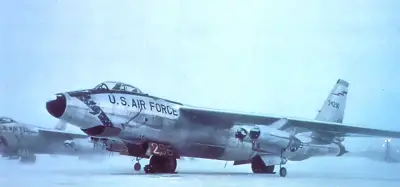
| Aircraft | RB-47H "Lacy 17", 55th Strategic Reconnaissance Wing, Forbes AFB, Kansas |
| Crew | Maj. Lewis D. Chase (pilot), James H. McCoid, Thomas H. Hanley, John J. Provenzano, Frank B. McClure, Walter A. Tuchscherer |
| Ground radar | 745th Aircraft Control and Warning Squadron, Duncanville, Texas ("Utah") |
| Verdicts | Blue Book: "American Airlines Flight 655"; Condon Report: unexplained (case 5) |
| Also known as | RB-47 case, RB-47 incident |
The RB-47 UFO encounter took place in the early hours of 17 July 1957, when the six-man crew of a U.S. Air Force RB-47H electronic reconnaissance aircraft reported that an unidentified source followed them for about an hour and a half and more than 700 miles across Mississippi, Louisiana, Texas and Oklahoma. At times it was seen by the pilots as an intensely luminous light, tracked by ground radar, and detected by the aircraft's electronic intelligence (ELINT) receivers as a radar-like signal — and on several occasions it appeared and disappeared on all three at once.[1][2]
Project Blue Book listed the case as an airliner, but the University of Colorado's Condon Committee classified it as unexplained, and the atmospheric physicist James E. McDonald made it one of his showcase cases. It is often cited as one of the strongest multi-sensor UFO cases, though skeptics have proposed that it combined a meteor, ground radars and an airliner.[1][3][4]
The mission

The RB-47H, call sign "Lacy 17", flew from Forbes Air Force Base in Topeka, Kansas, on a composite training mission: gunnery exercises over the Texas–Gulf area, navigation exercises over the open Gulf of Mexico, and electronic countermeasures (ECM) exercises on the return across the south-central United States. The crew were Major Lewis D. Chase, the pilot; James H. McCoid, co-pilot; Thomas H. Hanley, navigator; and three electronic warfare officers, or "Ravens", in the rear: John J. Provenzano (No. 1 monitor), Frank B. McClure (No. 2) and Walter A. Tuchscherer (No. 3).[1][4]
The ECM equipment consisted of passive direction-finding receivers, which do not transmit but listen for enemy radars and show the bearing of a signal as a strobe on a scope. McClure's No. 2 monitor used an ALA-6 receiver with spinning antennas under the tail, covering 1,000–7,500 MHz. Crucially, the strobe from a fixed ground radar always moves "down-scope" as an aircraft flies past it.[1]
The encounter
The "up-scope" signal
Flying at 34,500 feet and about 500 mph in perfectly clear weather, shortly after crossing the Mississippi coast near Gulfport, McClure picked up a signal at the five o'clock position that looked like an ordinary S-band ground search radar, near 2,800–3,000 MHz, with typical pulse width, repetition rate and scan. But the strobe moved up-scope on the right, crossed the flight path and moved down the left — behaviour impossible for a ground radar if the aircraft was flying straight. The wing intelligence report recorded a signal of 2,995–3,000 MHz moving rapidly "indicating a rapidly moving signal source; i.e. an airborne source". McClure asked whether they were turning, was told no, and dismissed it as an equipment problem, mentioning it to no one.[1][4]
The first light
After turning west near Meridian, Mississippi, at 1010 GMT (4:10 a.m. CST), near Winnsboro, Louisiana, Chase saw what he first took for the landing lights of another jet closing fast from his eleven o'clock. He saw no navigation lights and warned the crew to prepare for evasive action, but before he could react the intense bluish-white light flashed across in front of them from left to right, at an angular speed Chase said he never saw matched in twenty years of flying, and blinked out at about two o'clock. McCoid saw it too. Chase later said it was as large as a barn. "Well, it must be a flying saucer," one of them remarked, and they laughed about it on the intercom.[1][4]
Pacing the aircraft
Hearing this, McClure mentioned his earlier signal and set his receiver to about 3,000 MHz. He found a strong signal at the two o'clock bearing where the light had vanished. After checking the equipment on known ground radars, Provenzano tuned his own monitor and also got the signal. As the RB-47 flew west at 500 mph, the source did not move down-scope as a ground radar would but kept pace, holding a fixed relative bearing even when Chase went to maximum power. At 1039 GMT Chase saw a "huge light" about 5,000 feet below at two o'clock, with the impression that the light came from the top of an object; at 1040 McClure had two signals, and Chase and McCoid saw two red lights. Chase got permission to abandon his flight plan, called the Duncanville, Texas, ground radar station (code name "Utah") for help, and speeded up to Mach 0.83; the object pulled ahead.[1][4]
Near Fort Worth
When the crew reported the object about 10 nautical miles northwest of Fort Worth, Utah immediately confirmed a target on its scopes. At about 1050 GMT the object appeared to stop and the RB-47 overshot it; Utah lost it from its scopes and McClure lost the signal at the same moment. Chase said he passed over it, at a depression angle of about 45 degrees, as it blinked out. As he turned near Mineral Wells, Texas, the object reappeared visually, on McClure's monitor and on Utah's radar almost simultaneously. Chase closed to about 5 nautical miles and dived from about 35,000 to 20,000 feet toward it, and it vanished again from sight, from the monitor and from ground radar at once. Running short of fuel, the crew turned north for home at about 1120 GMT, and McClure kept a signal behind them until it faded abruptly near Oklahoma City at 1140 GMT. The wing intelligence report concluded that it had "no doubt the electronic D/F's coincided exactly with visual observations by aircraft comdr numerous times, thus indicating positively the object being the signal source".[1][4]
Blue Book

The base intelligence officer, Captain E. T. Piwetz, debriefed the crew and wrote a report, and the Duncanville station sent a teletype that morning. Chase filled out an Airborne Observer's Data Sheet on 10 September. These reached Project Blue Book only in the autumn, after Air Defense Command requested them. Blue Book's summary concluded that, in a joint review with the Civil Aeronautics Administration, the object seen near Dallas and Fort Worth had been "definitely established" to be an airliner, and filed the case as "American Airlines Flight 655" — which McDonald noted referred to a near-collision of two American Airlines DC-6s at 14,000 feet near Salt Flats, Texas, about 50 miles from El Paso, at 3:30 a.m. that day.[1]
The Condon investigation
The case came to the University of Colorado UFO Project only because Chase, by then the UFO officer at Malmstrom Air Force Base, mentioned it at a project conference for base UFO officers in Boulder in June 1967. The investigator Roy Craig interviewed Chase, McCoid and McClure — others were serving in Vietnam — and learned that the navigator had reportedly also had the target on his own radar. But the original file had been misdated to September 1957, so Craig could find no report in Blue Book or Air Defense Command records, and the committee's weather data, including those for Mineral Wells on 19 September, were for the wrong date. Chase believed scope photographs and wire recordings had been made, but others thought not. Craig concluded that the evaluation had to rest on the crew's recollections a decade later, which "are not adequate to allow identification of the phenomenon", and the Condon Report classified the case as unknown.[2][4]
McDonald and later analyses
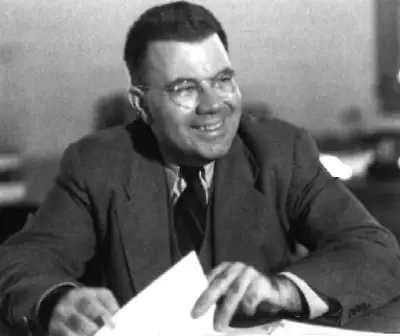
James McDonald identified the correct date, located the case file and, in 1969, interviewed the crew. In 1971 a subcommittee of the American Institute of Aeronautics and Astronautics published his analysis as one of two sample cases; Chase confirmed its accuracy. McDonald found the crew's recollections closely supported by the contemporary intelligence report, though the men had forgotten some details, such as the occasional second source.[1][3][5]
The skeptic Philip Klass, taking each element separately, proposed that the first up-scope signal was an equipment fault plus a radar near Biloxi, that the later signals came from ground radars, and that the visual sightings were an airliner and other ordinary lights. Nearly everyone who has studied the case agrees the first bright light was a meteor fireball; the researcher Brad Sparks, who regards the case as one of the strongest for UFOs, called it "the only part of the RB-47 incident having a mundane explanation", and argued that no ground radar could account for the first signal because the Keesler Air Force Base training radar was not operating. Tim Printy countered that the Keesler site could have been in use, and concluded he was not sure what the case proves. Kevin Randle notes that the source of the first signal has never been identified, but that it did mimic a radar of the time on the right frequency.[4]
References
- "RB-47 case file", The Black Vault · theblackvault.com · archived copy
- Condon Report, Case 5 · files.ncas.org · archived copy
- "UFO Encounter I: Sample Case Selected by the UFO Subcommittee of the AIAA" (1971) — NARCAP · narcap.org · archived copy
- Kevin Randle, "Lewis Chase and the RB-47", A Different Perspective (2021) · kevinrandle.blogspot.com · archived copy
- "The RB-47 UFO Encounter", HowStuffWorks · science.howstuffworks.com · archived copy
🛸 Sightings & submissions about this 1
This page was last edited on 31 October 2026. Articles are written in our own words from the sources listed under References; disputed claims are attributed to the people who made them.
No discussion yet.