Insectoid aliens
From the UAP Encyclopedia, the open encyclopedia of UFO and UAP history · 📖 Term
Contents 6

| Type | Term |
|---|
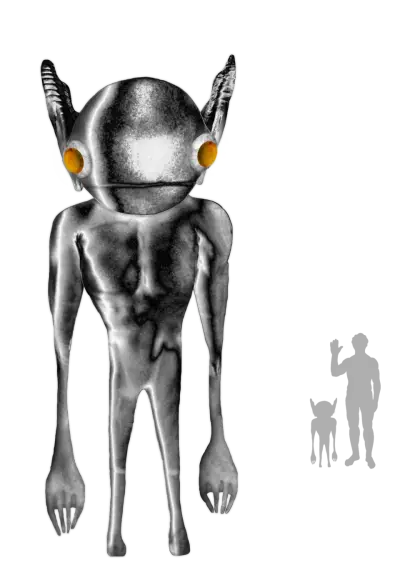
Insectoid aliens — often called mantis beings, "mantids" or "praying mantis aliens" — are insect-like entities described in a minority of alien abduction accounts. Witnesses usually compare them to a praying mantis: tall and thin, with long limbs, a triangular head and large eyes.[1][5] They are a much smaller part of UFO lore than the greys, Nordics or reptilians, but insect-like aliens have been a staple of science fiction since the first films and novels about other worlds.[2]
As with every type of alien in UFO lore, the descriptions come only from witness testimony, often recovered under hypnosis. There is no physical evidence that such beings exist.[1][4]
Description
Reports of mantis-like entities are scattered and do not agree on details. Two published examples show the range:
- The Cincinnati nurse (1957). Abduction researcher Brian Thompson says a nurse told him that in 1957 in Cincinnati she encountered a 3-foot-tall (90 cm) praying-mantis-like entity two days after seeing a V-shaped UFO. Thompson passed the report to fellow researcher Leonard Stringfield, who said he had two cases in his files in which separate witnesses described identical circumstances in the same place and year.[1] The Alien abduction article notes that the creature is "reminiscent of the insectoid-type entity reported in some abduction accounts".[1]
- A modern "experiencer". A feature on abduction experiencers in The Debrief quotes a Jersey City artist who co-hosts an online support group of about 200 people. He says he has met spindly, mantis-like beings that "communicate telepathically in florid English — and Latin", that they are taller than greys "with a different body structure", and that one about 6 feet tall once stepped halfway into his bedroom through a rectangular, pixel-like doorway in the wall in 2017.[5]
In these accounts the mantis beings are often presented as more intelligent or senior than the greys. The same experiencer described their telepathy as "much more elegant" than the line-by-line, "telegram"-like messages he said he got from greys.[5]
In abduction research
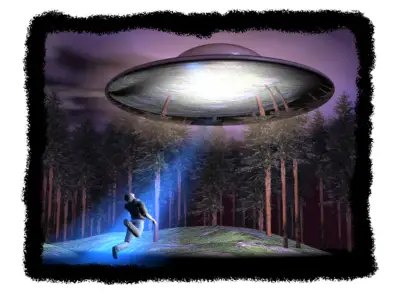
Mantis beings are reported within the abduction literature that grew out of the hypnosis-based research of the 1980s. The artist Budd Hopkins and the Temple University historian David M. Jacobs both hypnotised their own experiencers and became convinced that abductions were literal events carried out by aliens with an agenda hostile to humanity.[5] Jacobs and Hopkins argued that tens of thousands or more North Americans had been taken, and that the aliens were running a programme to breed human–alien hybrids.[1] Jacobs later argued that such hybrids were secretly infiltrating human society, possibly with the final goal of taking over the Earth.[4]
Within this "detailed mythos", the abduction subculture assigns the different aliens — greys, reptilians, Nordics and so on — specific roles, origins and motives.[1] Psychiatrist John E. Mack, who also worked with abductees, came to doubt that the experiences were literal, physical events and suggested they were more "liminal", or perhaps intrusions from another dimension.[5]
Critics including Carl Sagan, Susan Clancy and Martin Gardner have criticised the methods of Jacobs and other abduction researchers. Sagan attributed the experiences to mistaken identity and faulty memory; Clancy pointed to faulty memory retrieval when hypnotists "lead" their subjects, and to sleep paralysis; Gardner noted that Jacobs had no training in psychology or hypnotherapy yet used hypnosis to help hundreds of people develop "strong memories of horrendous abductions" that many had not had before.[4] Folklorist Thomas E. Bullard, who compared nearly 300 abduction reports, found that some elements popularised by Hopkins and Jacobs had "no clear antecedents" in earlier accounts.[1]
Insect aliens in science fiction

Insect-like extraterrestrials are among the oldest aliens in fiction, which is one reason sceptics see cultural influence in the reports.[2]
- The Selenites. In H. G. Wells's novel The First Men in the Moon (1901), two Englishmen reach the Moon and find a sophisticated underground civilisation of insect-like "Selenites", ruled by the Grand Lunar.[7] Wells's lunar hive is credited as the origin of the hive-mind theme in science fiction.[2]
- Méliès. In Georges Méliès's film A Trip to the Moon (1902), the Moon's inhabitants are again insectoid Selenites, who explode when struck.[6]
- The pulps. Insect creatures were common villains threatening the damsel in distress in pulp fiction.[2] Science fiction of the 1920s to 1960s was full of "bug-eyed monsters" — grotesque creatures with huge or compound eyes — so common that readers called them "BEMs".[3]
- Later works. Olaf Stapledon's Star Maker (1937), the "Bugs" of Robert A. Heinlein's Starship Troopers (1959) and the "buggers" of Orson Scott Card's Ender's Game series (from 1985) continued the tradition.[2] The Deadly Mantis (1957) featured a giant mantis threatening mankind.[8]
The Bug-eyed monster article notes that in contactee and abductee mythology the friendly Nordic aliens of the 1950s were soon replaced by small, unfriendly bug-eyed creatures "closely matching in many respects the pulp cover clichés of the 1930s", which have remained the norm since the 1960s.[3] Writers have described insectoids as "almost a cliche" for representing alien life.[2]
Carl Sagan complained of stories that "simply ignore what we know of molecular biology and Darwinian evolution", adding that giant spiders menacing cities would suffocate, since insects and arachnids breathe by diffusion.[2]
The mantis in older beliefs

The praying mantis has long had a special place in human belief. Ancient Greece, ancient Egypt and Assyria credited mantises with supernatural powers, and the name mantis comes from the Greek for "prophet".[8] The Khoi and San of southern Africa revered the mantis; for the San it was one form of the trickster deity ǀKaggen, a shape-shifter who could also become an eland, a louse, a snake or a caterpillar.[8][9] Some modern believers link these traditions to mantis aliens, but the sources on ǀKaggen describe a trickster god of San folklore, not a visitor from space.[9]
Evidence
No physical evidence of insectoid aliens has been produced. The reports rest on a small number of individual testimonies, several of them recovered through hypnosis, and the beings described resemble long-standing science-fiction imagery.[1][2][4]
See also: types of aliens, grey aliens, reptilians, Nordic aliens, little green men, tall whites.
References
- Alien abduction — Wikipedia · en.wikipedia.org
- Insectoids in science fiction and fantasy — Wikipedia · en.wikipedia.org
- Bug-eyed monster — Wikipedia · en.wikipedia.org
- David M. Jacobs — Wikipedia · en.wikipedia.org
- "The Experience: The Cultural Rise of Alien Abductions and Those Who Encounter Them" — The Debrief · thedebrief.org
- A Trip to the Moon — Wikipedia · en.wikipedia.org
- The First Men in the Moon — Wikipedia · en.wikipedia.org
- Mantis — Wikipedia · en.wikipedia.org
- ǀKaggen — Wikipedia · en.wikipedia.org
Facts in this article are drawn in part from the Wikipedia articles “Alien abduction”, “Insectoids in science fiction and fantasy”, “Bug-eyed monster”, “David M. Jacobs”, “A Trip to the Moon”, “The First Men in the Moon”, “Mantis”, “ǀKaggen”, available under the CC BY-SA 4.0 licence.
This page was last edited on 14 November 2026. Articles are written in our own words from the sources listed under References; disputed claims are attributed to the people who made them.




No discussion yet.