Little green men
From the UAP Encyclopedia, the open encyclopedia of UFO and UAP history · 📖 Term
Contents 8

| Type | Term |
|---|
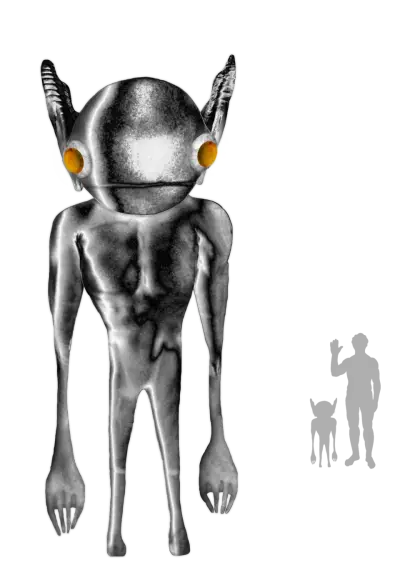
Little green men are the stereotypical extraterrestrials of popular culture: little humanoids with green skin and sometimes antennae on their heads.[1] The phrase came into popular use for aliens during the flying-saucer reports of the 1950s, almost always as a joke, and it is one of the oldest types of alien in the public imagination — older, as an image, than the greys that replaced it in abduction stories.[1]
Very few actual witnesses have described small green beings. The best-known case linked to the phrase, the 1955 Kelly–Hopkinsville encounter, involved creatures that the witnesses described as silvery, not green; the colour was added by newspapers.[1][2]
Before flying saucers
The idea of small green people is far older than ufology. In England, stories of green children go back to the 12th-century legend of the green children of Woolpit, Suffolk: two children with greenish skin who spoke an unknown language, would eat only raw broad beans, and — according to the girl, once she had learned English — came from a land where the sun never shone.[1][5] The only near-contemporary accounts were written by William of Newburgh and Ralph of Coggeshall in about 1189 and 1220. The story has been explained both as a folktale about visitors from another world, perhaps underground or extraterrestrial, and as a garbled account of a real event.[5]
In his satire A History of New York (1809), Washington Irving described "Lunatics", or men from the Moon, as "pea green". Science-fiction scholar Adam Roberts writes that these may be the first green aliens in literature.[1]
Folklore researcher Chris Aubeck searched old newspapers electronically and found a number of green aliens from around the turn of the 20th century:[1]
- an 1899 tale in the Atlanta Constitution, "Green Boy From Hurrah", about a little green-skinned alien from another planet, perhaps Mars;
- the first use he found of the exact phrase "little green man" for an extraterrestrial, in the Daily Kennebec Journal of Augusta, Maine, in 1908 — again about Martians;
- Edgar Rice Burroughs's "green men of Mars" in A Princess of Mars (1912), though at 10 to 12 feet tall they were hardly little.
There is also a story that in 1910 (or 1915) a "little green man" was captured from his crashed spaceship in Apulia, in south-east Italy.[1]
"Little green men" had other meanings too. The phrase was used for goblins and other supernatural beings in folklore, fairy tales and children's books — Rudyard Kipling has a "little green man" in Puck of Pook's Hill (1906), and a 1902 children's book reviewed in The New York Times featured a "Little Green Man" who helps a boy visit the cloudland fairies.[1] Newspapers used it for imaginary beings seen in hallucinations (1923, 1936), for a child's imaginary friend (1948), for small cast members of The Wizard of Oz (1939) and, in 1942, for camouflaged Japanese soldiers.[1] Aubeck and others suspect that because the phrase was already so familiar, it attached itself to flying-saucer occupants naturally once speculation about alien visitors began in 1947.[1]
Pulps, saucers and the press

Green aliens were common on the covers of science-fiction pulp magazines from the 1920s to the 1950s, with heroes such as Buck Rogers and Flash Gordon battling green alien monsters.[1]
The first documented example linking "little green men" to alien spaceships is a newspaper column mocking the panic after Orson Welles's War of the Worlds broadcast of 31 October 1938. Reporter Bill Barnard's column in the Corpus Christi Times the next day began: "Thirteen little green men from Mercury stepped out of their space ship at Cliff Maus Field late yesterday afternoon for a good-will visit to Corpus Christi."[1]
After that the image spread quickly:[1]
- 1946. Harold M. Sherman published The Green Man: A Visitor From Space, whose cover showed a normal-looking human being with green skin.
- July 1947. At the height of the first flying-saucer wave, which followed Kenneth Arnold's sighting on 24 June and the Roswell incident, the syndicated humorist Hal Boyle wrote about a green man from Mars in his flying saucer — though not a small one.
- 1950. Newspapers began running stories about little beings recovered from crashed saucers. Though largely considered hoaxes, some made it into Frank Scully's best-selling Behind the Flying Saucers. A Wichita, Kansas, man reporting a saucer in June 1950 told the local paper he saw "absolutely no little green men with egg on their whiskers".
- 1951. Mack Reynolds's novel The Case of the Little Green Men, about a detective investigating disguised aliens, had a cover showing the classic antennae. The same year the phrase appeared in The New York Times and The Washington Post, followed in 1952 by the Los Angeles Times and the Chicago Tribune (which mocked saucer reports with a "little green man with pink polka dots").
- 1955. The New York Times described the obnoxious Martians of the satire Martians, Go Home as "little green men" whose looks were "true to prophecy".
By 1954 the image of little green men had become part of the public's collective consciousness, and it was used almost always sarcastically for the occupants of flying saucers.[1] After a burst of sightings in November 1957, the columnist Frederick Othman wrote that "no little green men have climbed out of these celestial vehicles so far".[1]
The Kelly–Hopkinsville encounter

On the evening of 21 August 1955, five adults and seven children arrived at the police station in Hopkinsville, Kentucky, saying that small alien creatures from a spaceship had been attacking their farmhouse near Kelly and that they had held them off with gunfire "for nearly four hours". Two of the men said they had been shooting at short, dark figures that kept popping up at the doorway and windows.[2] Police, state troopers, deputies and military police from Fort Campbell found nothing but broken windows and holes in screens, possibly from the gunfire.[2]
The Little green men article notes that the witnesses actually described metallic-silver, somewhat humanoid beings no more than four feet tall; it was The Evansville Courier, using "journalistic license", that called them "little green men", and other papers followed.[1] Early articles did not mention the colour, and details such as "large pointed ears, clawlike hands, eyes that glowed yellow and spindly legs" appeared later.[2]
Project Blue Book listed the case as a hoax. Sceptic Joe Nickell suggested the family may have seen aggressive great horned owls, which are nocturnal, fly silently, have yellow eyes and stand about two-thirds of a metre tall, and that a meteor explained the bright light one man saw.[2] The case is also known as the "Kelly Green Men Case", and the Kelly community holds an annual Little Green Men Days Festival.[2]
The Flatwoods "green monster"

Another 1950s case gave a small town a green monster. On 12 September 1952 in Flatwoods, West Virginia, a group of boys and adults followed a bright light to a farm and said they saw a figure about 10 feet tall with a round, blood-red face inside a spade-shaped hood and a body that was either dark black or green.[3] Joe Nickell later concluded that the light was a meteor, the pulsing red glow an aircraft beacon, and the creature a startled barn owl on a branch. The town nevertheless put up a sign calling itself the "Home of the Green Monster".[3] See Flatwoods monster.
From green to grey
The phrase spread through the 1960s, always used in a mocking or humorous way.[1] A 1960 Chicago Tribune front page opened, "If there really are 'little green men' out there in space, there are probably also little green women–and sex", and said the name came from astronomer Otto Struve, director of the National Radio Astronomy Observatory at Green Bank, West Virginia.[1] The Wall Street Journal used it in 1960 about NASA's Brookings Report on the effects of discovering alien life, in 1968 about a planned congressional UFO inquiry, and in 1969 when it called the Condon Committee study a waste of money.[1] The Flintstones even had a recurring little green man, the Great Gazoo, with a helmet and antennae.[1]
The 1960s also marked a change in how people imagined aliens. In abduction stories they became small but grey, and in Arthur C. Clarke's 2001: A Space Odyssey (1968) they are never seen at all.[1] See grey alien.
LGM-1: the pulsar

In 1967 Jocelyn Bell Burnell, a PhD student at Cambridge working with Antony Hewish, found a radio signal with a period of about 1.337 seconds. Its almost perfect regularity briefly made it look like an alien beacon, and the discoverers jokingly named it LGM-1 — "little green men 1".[4] Bell Burnell soon found a similar signal from another part of the sky, which made an extraterrestrial source unlikely, and Thomas Gold and Fred Hoyle identified the source as a rapidly rotating neutron star.[4] Now called PSR B1919+21, it was the first pulsar discovered. Looking back, the researchers said they "did not really believe that we had picked up signals from another civilization, but obviously the idea had crossed our minds."[4] An image of its radio pulses later became the cover of Joy Division's album Unknown Pleasures (1979).[4]
Other uses
In 2014, at the start of the Russo-Ukrainian War, pro-Russian forces in modern Russian equipment but without badges or insignia were called "little green men" or "Martians" by locals and the media.[1]
See also: types of aliens, grey aliens, Nordic aliens, reptilians, insectoid aliens, tall whites.
References
- Little green men — Wikipedia · en.wikipedia.org
- Kelly–Hopkinsville encounter — Wikipedia · en.wikipedia.org
- Flatwoods monster — Wikipedia · en.wikipedia.org
- PSR B1919+21 — Wikipedia · en.wikipedia.org
- Green children of Woolpit — Wikipedia · en.wikipedia.org
Facts in this article are drawn in part from the Wikipedia articles “Little green men”, “Kelly–Hopkinsville encounter”, “Flatwoods monster”, “PSR B1919+21”, “Green children of Woolpit”, available under the CC BY-SA 4.0 licence.
This page was last edited on 14 November 2026. Articles are written in our own words from the sources listed under References; disputed claims are attributed to the people who made them.
No discussion yet.